Formal
Algorithm
Common
Docker
Javascript
Network
Node
Notes
c++
c++Lib
golang
Javascript
Webpack
Vite
Webassembly
MCU
Protocol
ML
Compilation
DataStructure
Algorithm
MC_MP_Programming
ResearchMethod
PrivacySecurity
EfficientAlgorithm
AdvancedAlgorithmicTech
AlgorithmGameTheory
LowCodeProject
ComputerCompose
Network
LinearMath
OperationSystem
Mathmatic
Non-atomic congestion games: Wardrop Model
Wardrop Model
-
directed graph G = (V,E)
-
kcommodities,oneforeachi∈[k]
- si , ti … source-sink pair
- ri … flow demanPd to route from si to ti I normalise: r = i∈[k] ri = 1
- Pi … set of paths between si and ti
-
P = Ui∈[k]Pi a set of paths
-
ce : [0,1] → R… latency (cost) function of edge e ∈ E
-
continuous, non-decreasing, non-negative
-
The triple (G,r,c) is an instance of the routing problem
-
Flow and Latency:
- Flow f: aPflow vector (fP)P∈P
- f_e= P ∋ e f_P
- a P flow is feasible if for all i∈[k] P ∈ Pi f_P = r_i
-
C_e(f) = c_e(f_e) … edge (lentence / cost)
-
C_p(f) = Sum e ∈ P c_e(f) … path latency
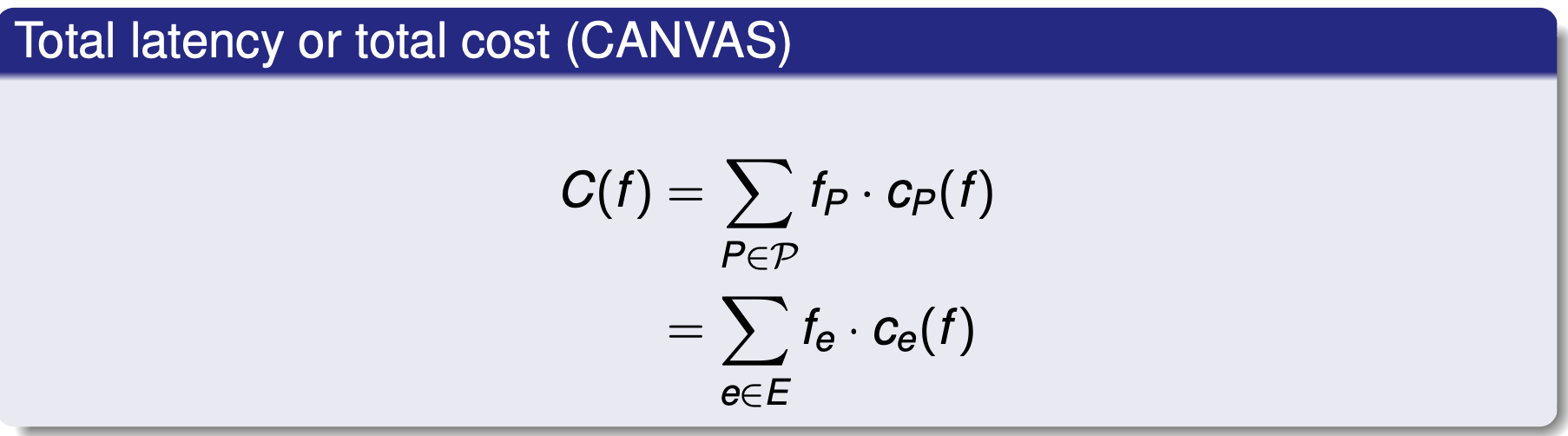
- Example:
Paths:
- P1=(e1,e2)…fP1 = 1 / 3
- P2 = (e1,e3,e5) … fP2 = 2 / 3
- P3=(e4,e5)…fP3 =0
Assume path flow f = (1/3, 2/3,0).
Edge flows:
fe1 =1,fe2 = 1/3,fe3 = 2/3,fe4 =0,fe5 = 2/3.
Edge costs:
ce1(f)=1, ce2(f)=1/3 + 2/3 =1, ce3(f)=3, ce4(f)=5, ce5(f)=3 * (2/3) =2.
Path costs: cP1 (f ) = ce1 (f ) + ce2 (f ) = 2, cP2 (f ) = ce1 (f ) + ce3 (f ) + ce5 (f ) = 6, cP3 (f ) = ce4 (f ) + ce5 (f ) = 7.
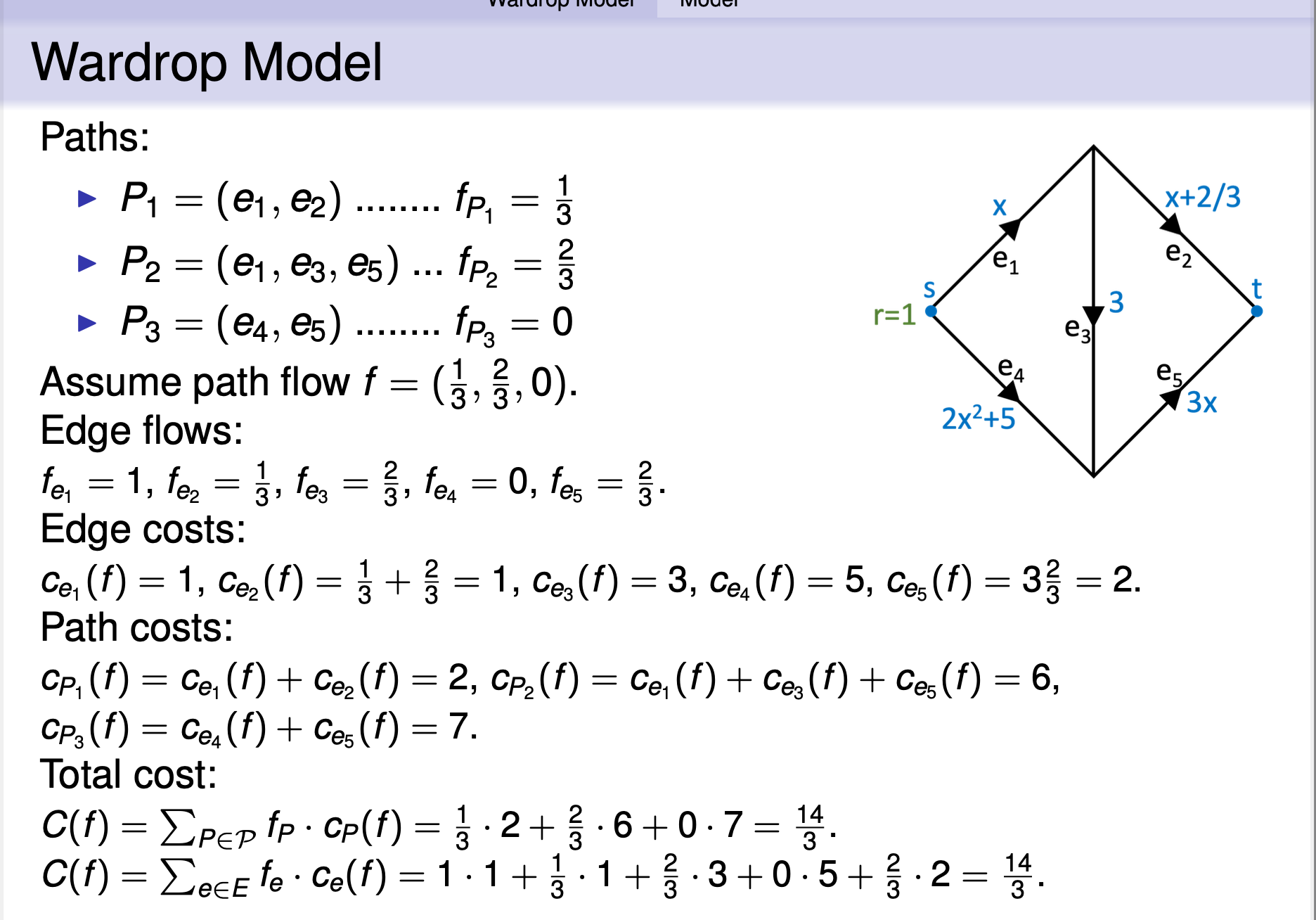
Total cost:
C(f) = Sum fp * cp = 1/3 * 2 + 2/3 * 6 + 0 * 7 = 14/3
C(f)= fe·ce(f)= 1·1 + 1/3 * 1 + 2/3 * 3 + 0 * 5 + 2/3 * 2 = 14/3
-
So far,we basically just introduced a flow model.
-
In the Wardrop model we assume:
-
flow is controlled by an infinite number of agents
-
each agent is responsible for an infinitesimal fraction of the flow
-
agents strive to minimise their own latency
-
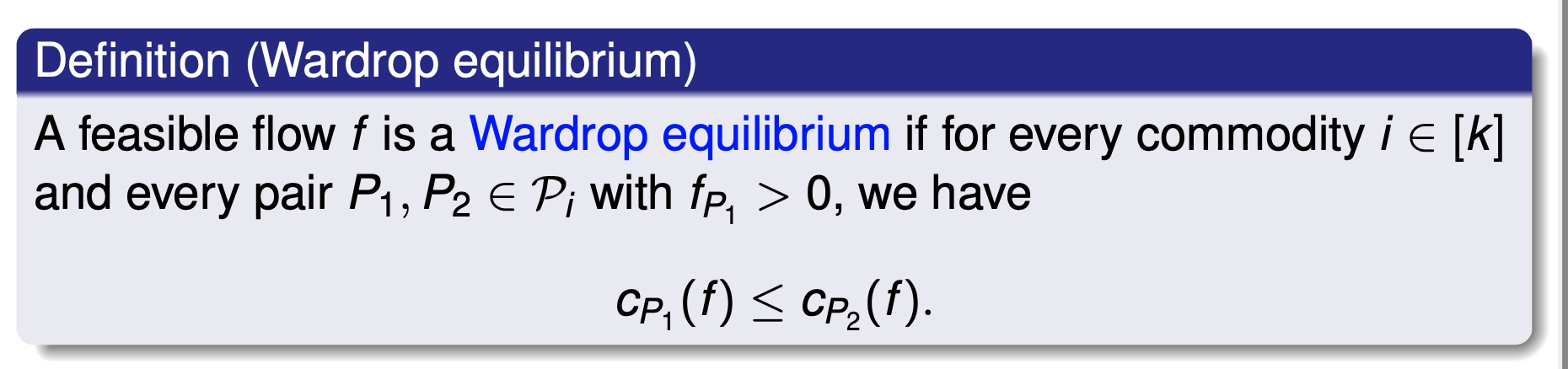
- This implies: All used paths of the same commodity have the same latency.
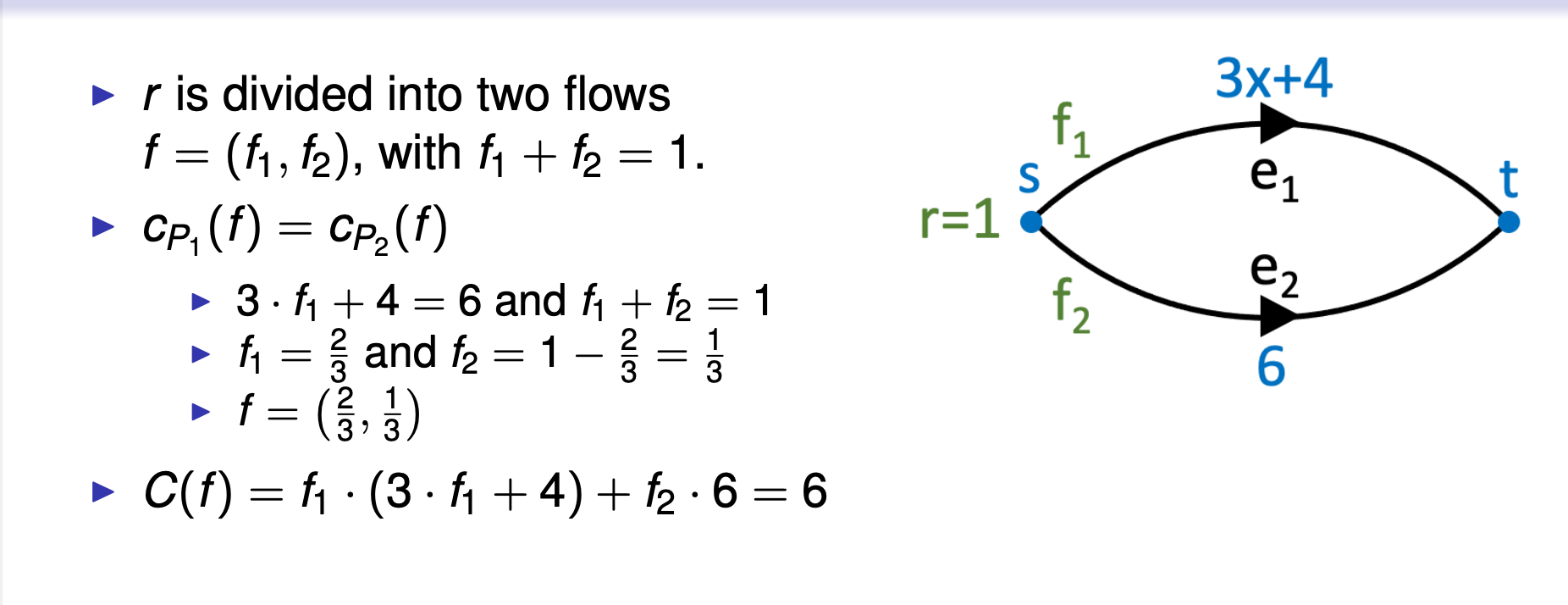
Optimal Flows & Wardrop Equilibria
-
Suppose we are shifting flow from path P1 to P2.
-
⇒ Contribution of edges on P1 to total latency decreases, contribution of P2 increases.
-
If decrease on P1 is more than the increase on P2 then total latency decreases.
-
⇒the flow was not optimal.
-
Marginal Cost (边际成本)

Optimum Flow via marginal costs
Assume x · ce (x ) is convex and continuously differentiable for all e ∈ E
- Lemma 3.1 (Characterisation of optimal flows) 最优流的特点
A feasible flow f is optimal if and only if for all commodities i ∈ [k], and paths P1,P2 ∈ Pi with fP1 > 0, we have cP∗ (f) ≤ cP∗ (f).
-
Observe the similarity in the characterisation of optimal flows and Wardrop equilibria.
-
Theorem 3.2 (Wardrop equilibrium vs. Optimum). 比较
A feasible flow f is optimal for (G,r,c) if and only if f is a Wardrop equilibrium for (G,r,c∗).
- Theorem 3.3 (Existence and essential uniqueness)
(a) Every instance (G,r,c) admits a Wardrop equilibrium. (CANVAS)
(b) If f and ̃f are Wardrop equilibria, then ce(f) = ce( ̃f) for every e ∈ E.
-
Proofs are based on the following potential function [ BECKMANN, MCGUIRE, WINSTON,1956] :
$H(f) = \sum_{e ∈ E} h_e(f_e)$
$he(x) = \int_0^x ce(u) du$
Price of Anarchy
- Let f be a Wardrop equilibrium and f ∗ be an optimum for (G, r , c).
ρ(G,r,c)= C(f) / C(f∗)
- Theorem 3.4 (polynomial latency functions) 多项式延迟函数
Suppose latency functions are of the form $ce(x) = \sum_{i = 0}^d ae&, i * xi$ with nonnegative coefficients, Then ρ(G, r, c) <= d + 1
- Theorem 3.5 (linear latency functions) 线性延迟函数
Suppose latency functions are linear with non-negative slope and offset. Then, ρ(G,r,c) = 4/3.
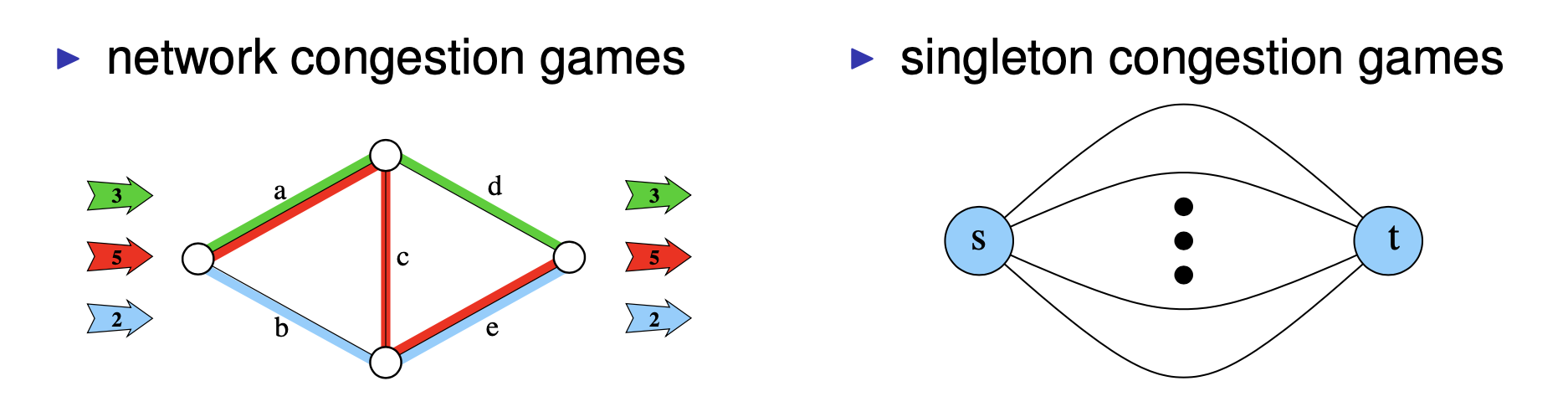
(Atomic) congestion games
-
(Weighted) congestion games
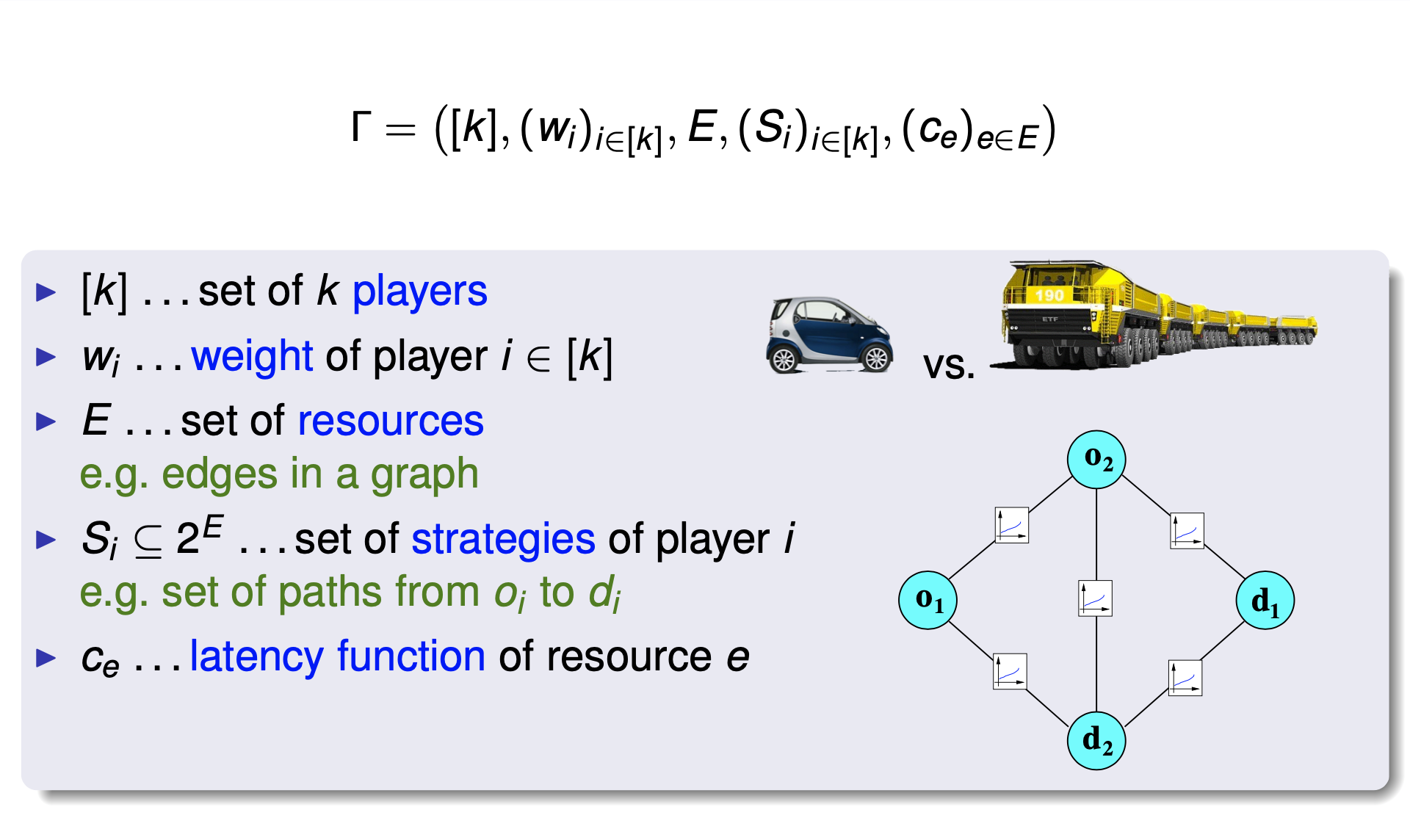
-
unweighted congestion games(or simply congestion games):
wi =1 for all players i ∈[k]
-
symmetric games:
Si = Sj for all player i,j ∈ [k]
-
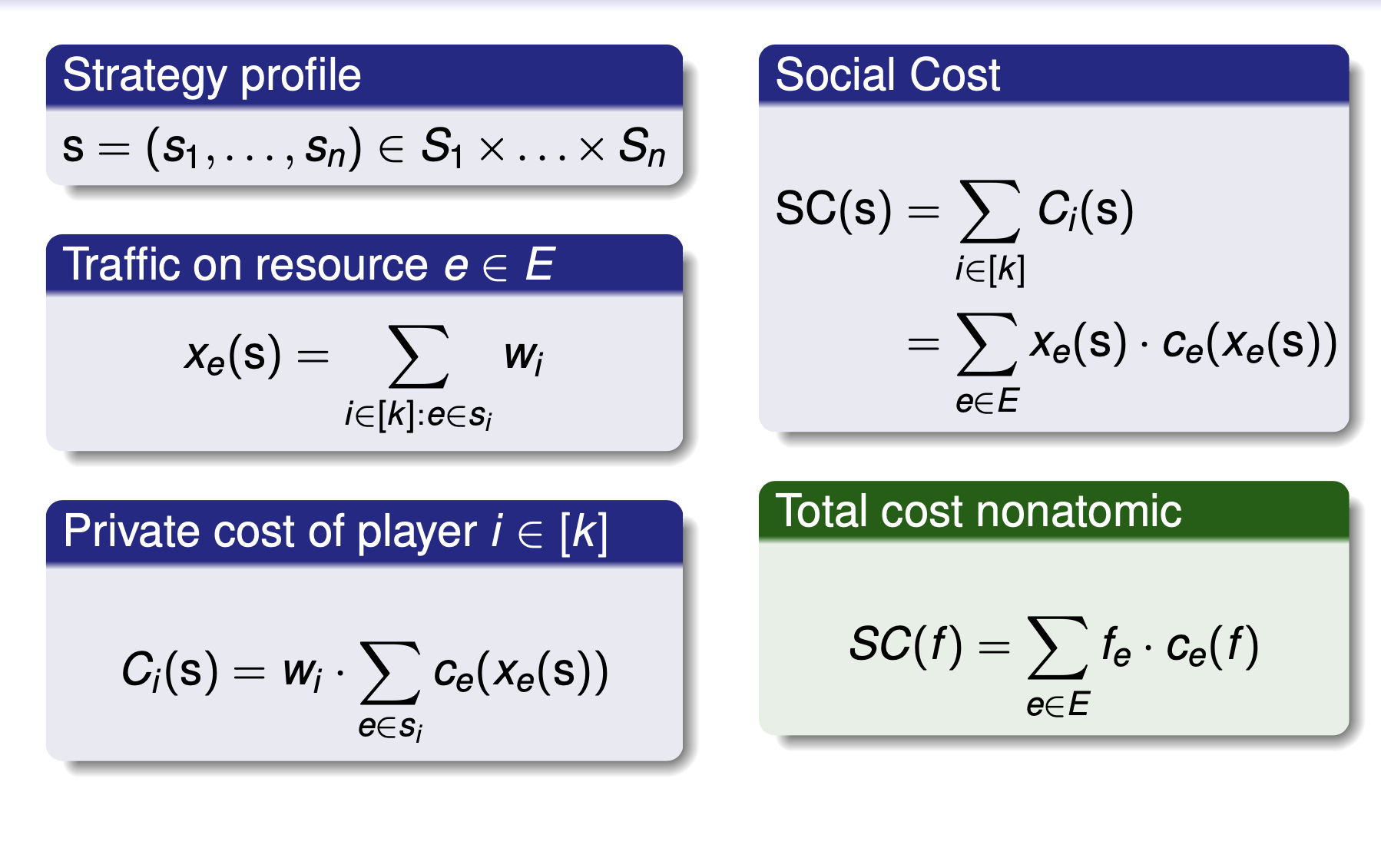
Private Cost and Social Cost
Nash Equilibrium
A strategy profile s is a Nash equilibrium if and only if all players i ∈ [k] are satisfied, that is, Ci(s) ≤ Ci(s−i,si′) for all i ∈ [k] and si′ ∈ Si.
- Remarks
- For simplicity were strict to pure Nash equilibria.
- Many result shold also for mixed Nash equilibria.
- Players randomize over their pure strategies
- Guaranteed to exist [ NASH, 1951]
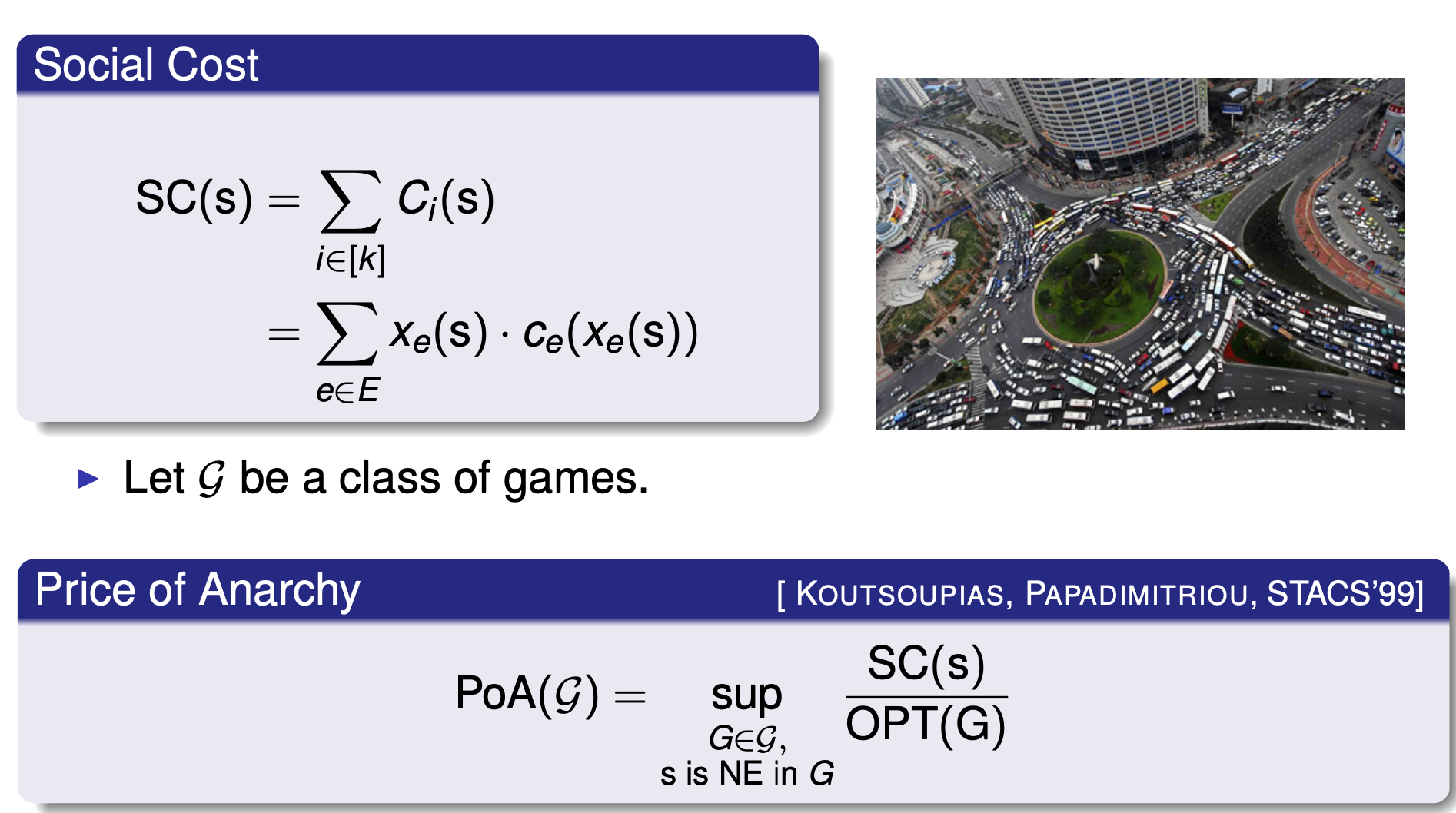
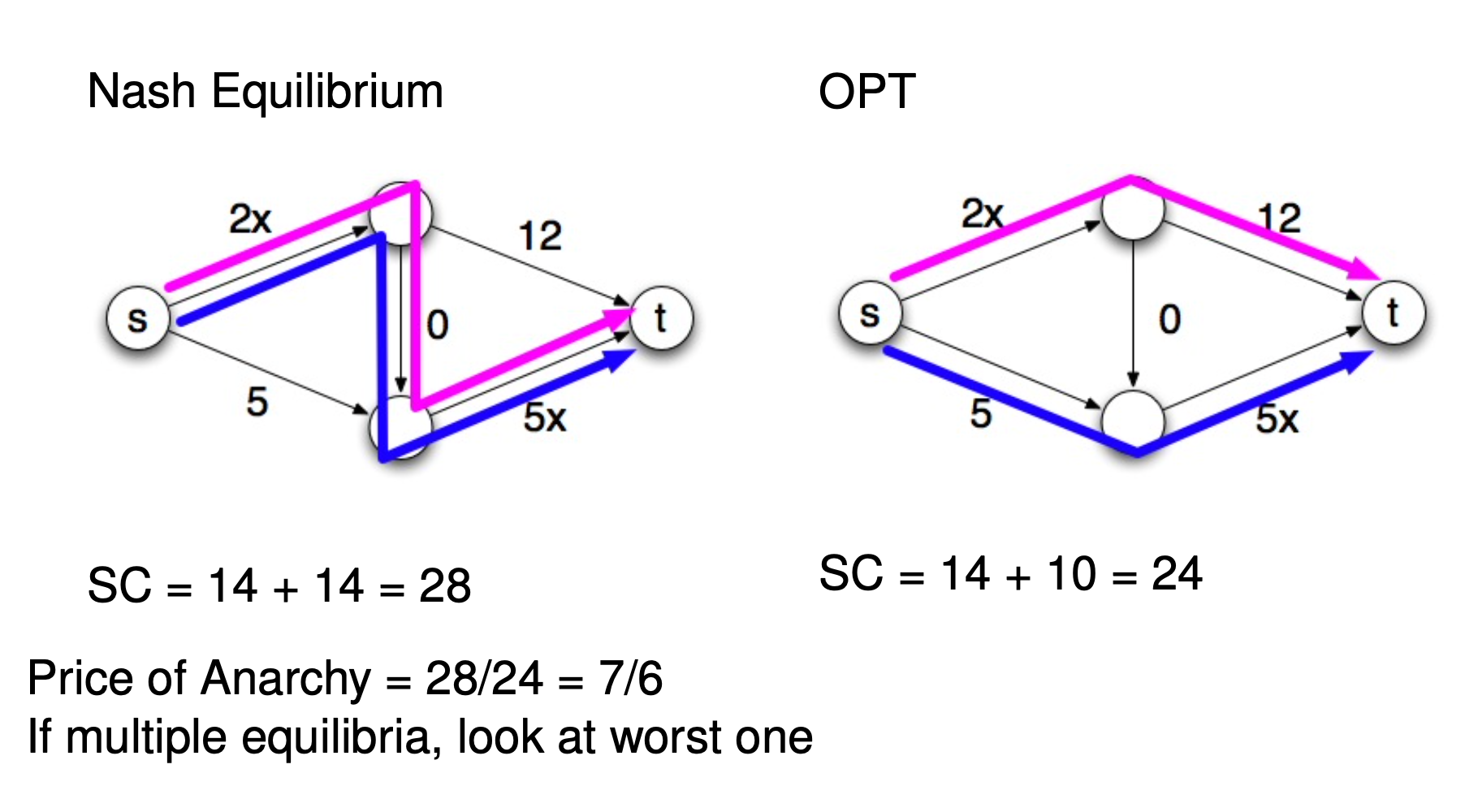
Price of Anarchy
Existence of pure NE: positive result
- Theorem 3.6
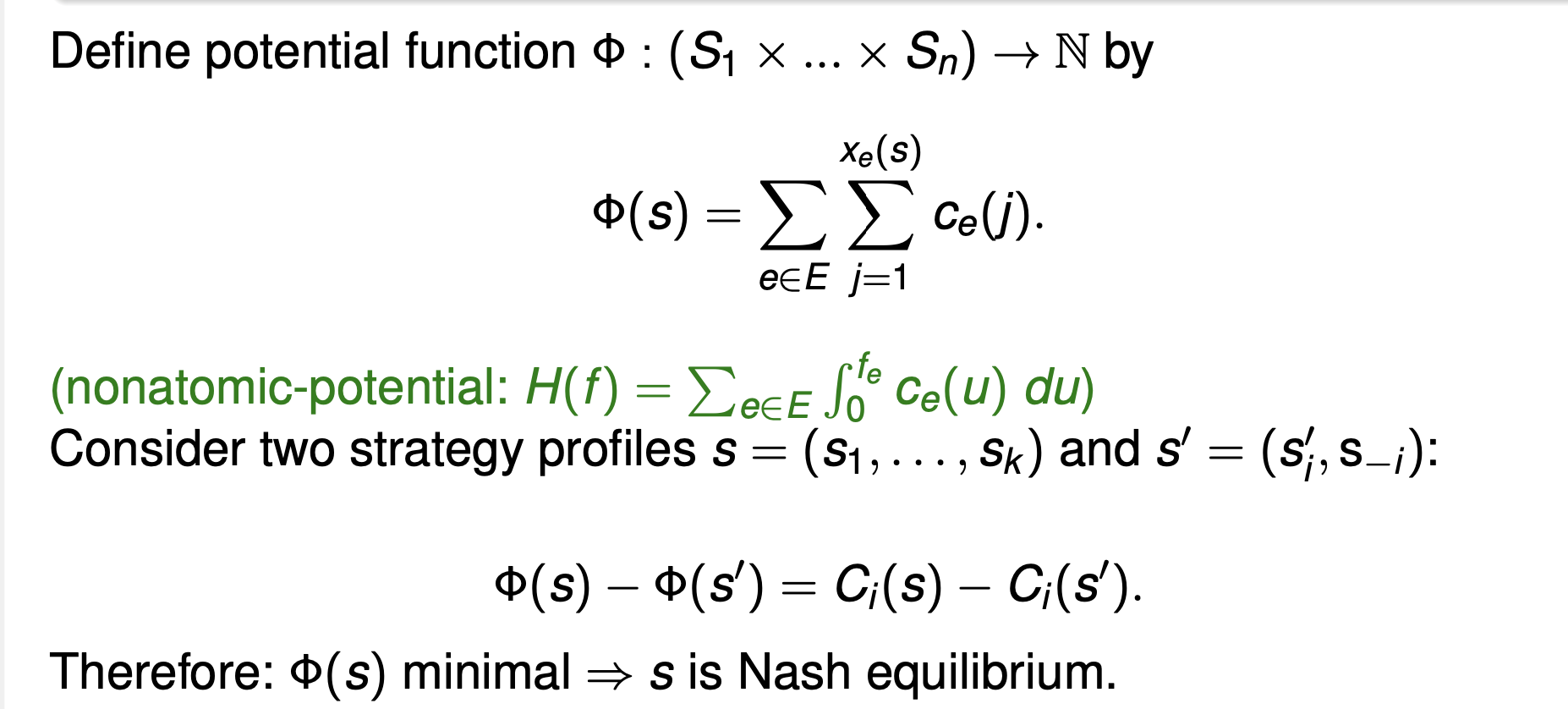
Every unweighted congestion game possesses a pure Nash equilibrium.
Potential Games and Price of Stability
-
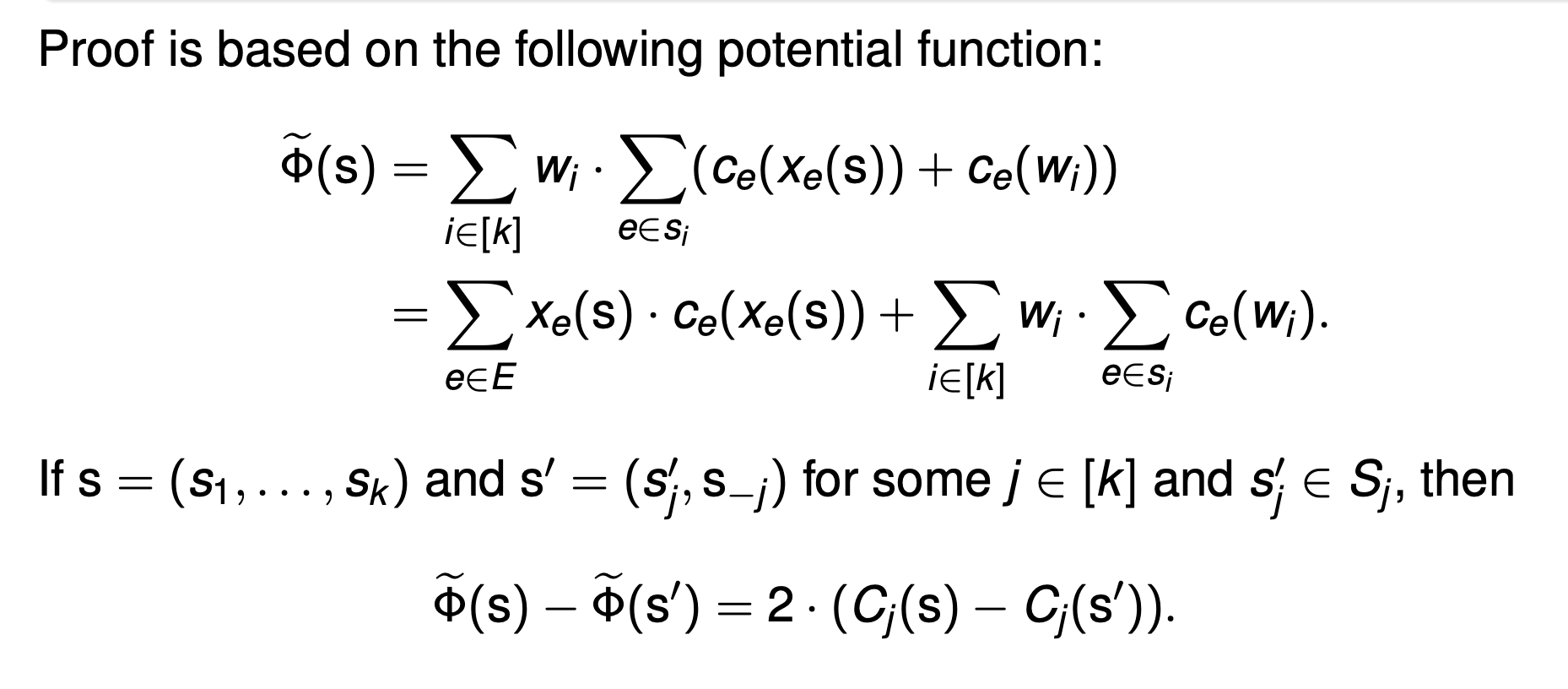
Potential Games: AllgamesthatadmitapotentialfunctionΦ,s.t.foralloutcomess, all player i, and all alternative strategies si′,
Ci (si′, s−i ) − Ci (s) = Φ(si′, s−i ) − Φ(s).
-
Every congestion game is a potential game.
-
For every potential game there exists a congestion game having the same potential function.
-
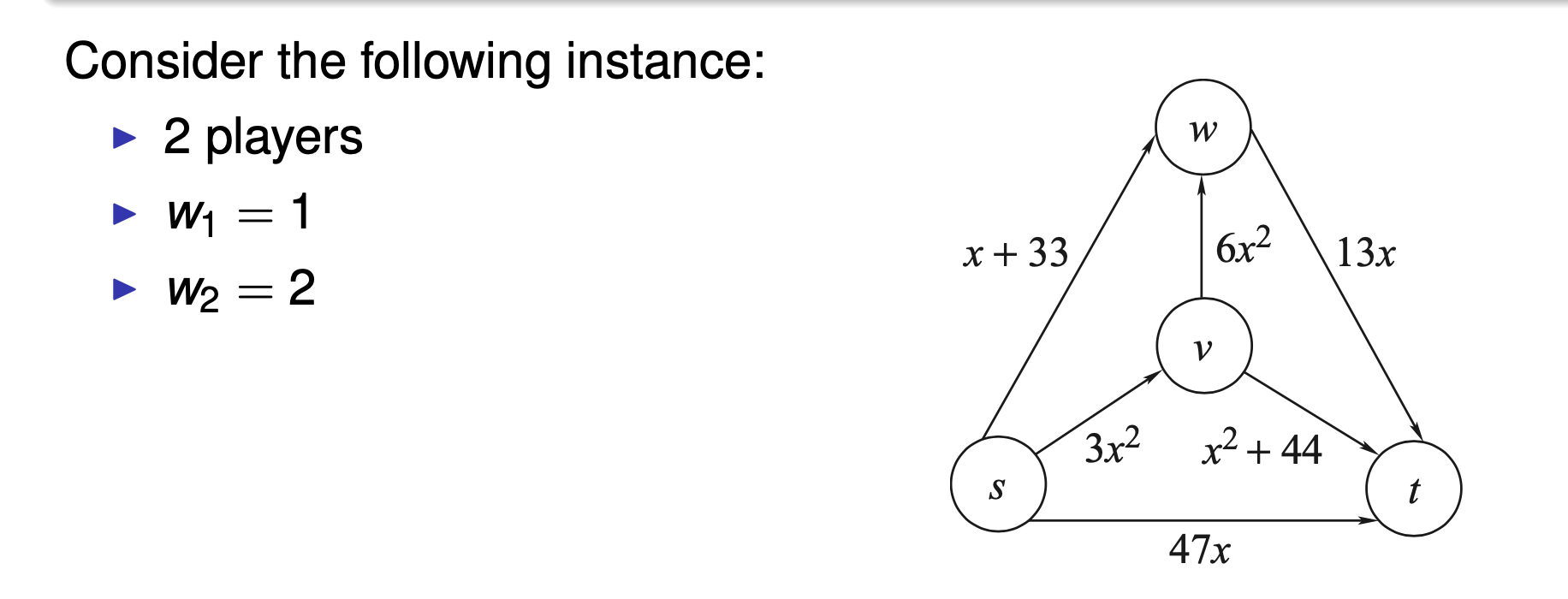
Theorem 3.7
- There is a weighted network congestion game that does not admit a pure Nash equilibrium.
-
Theorem 3.8
- Every weighted congestion game with linear latency functions possesses a pure Nash equilibrium.
-
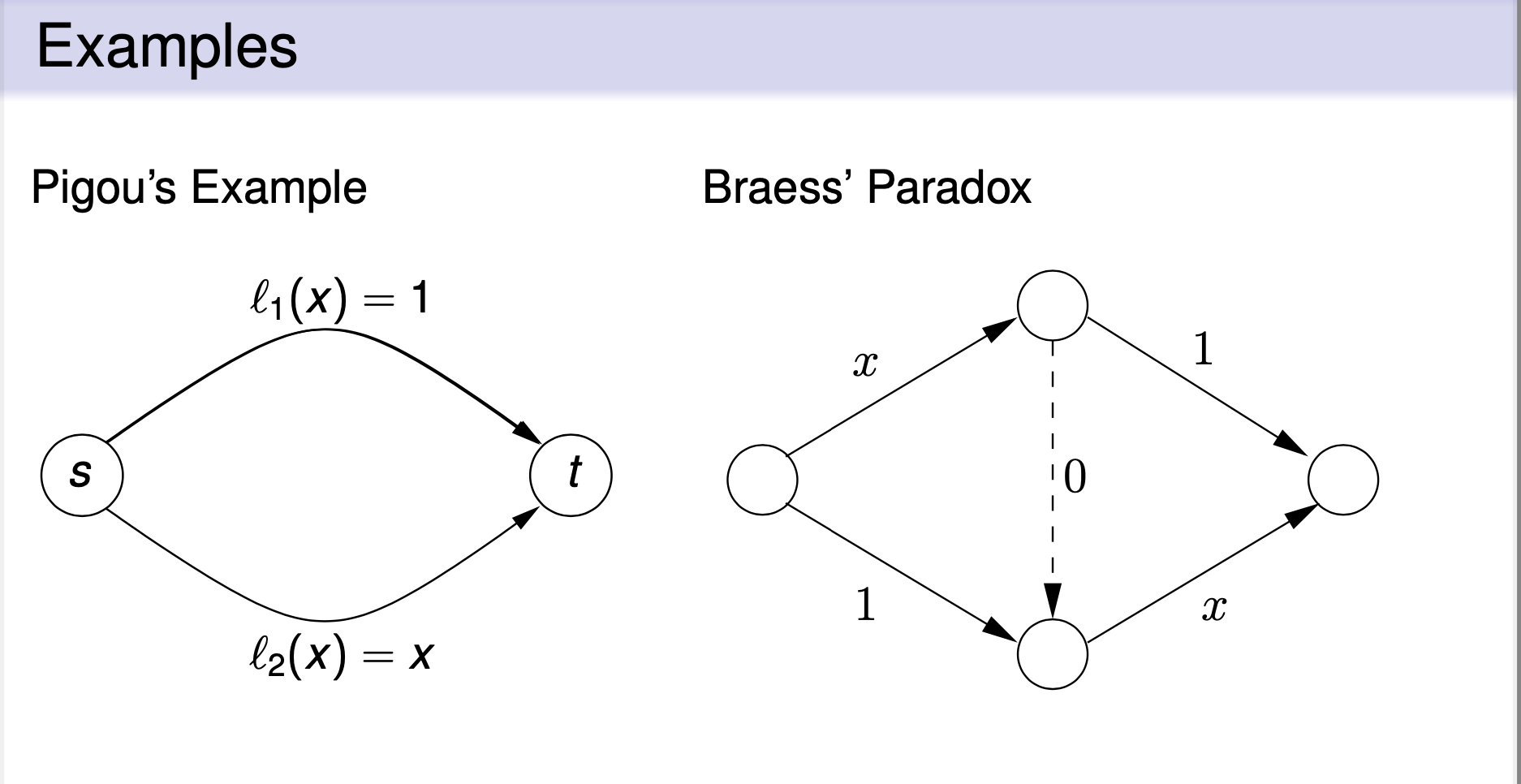
Pirce of Anarchy Example:
Price of Anarchy: Routing Games
-
Analytical simple classes of cost functions ⇒ exact formula for PoA.
-
Linear
-
bounded degree polynomials 有界次多项式
-
-
Theorem 3.9
-
Suppose latency functions are linear with non-negative slope and offset. Then for unweighted games the PoA is exactly 5/2.
// 假设延迟函数是线性的,具有非负斜率和偏移。对于未加权的游戏,PoA 恰好是 5/2。
-
-
For every set of allowable cost functions ⇒ recipe for computing PoA.
-
non-atomic (Wardrop model)
-
unweighted
-
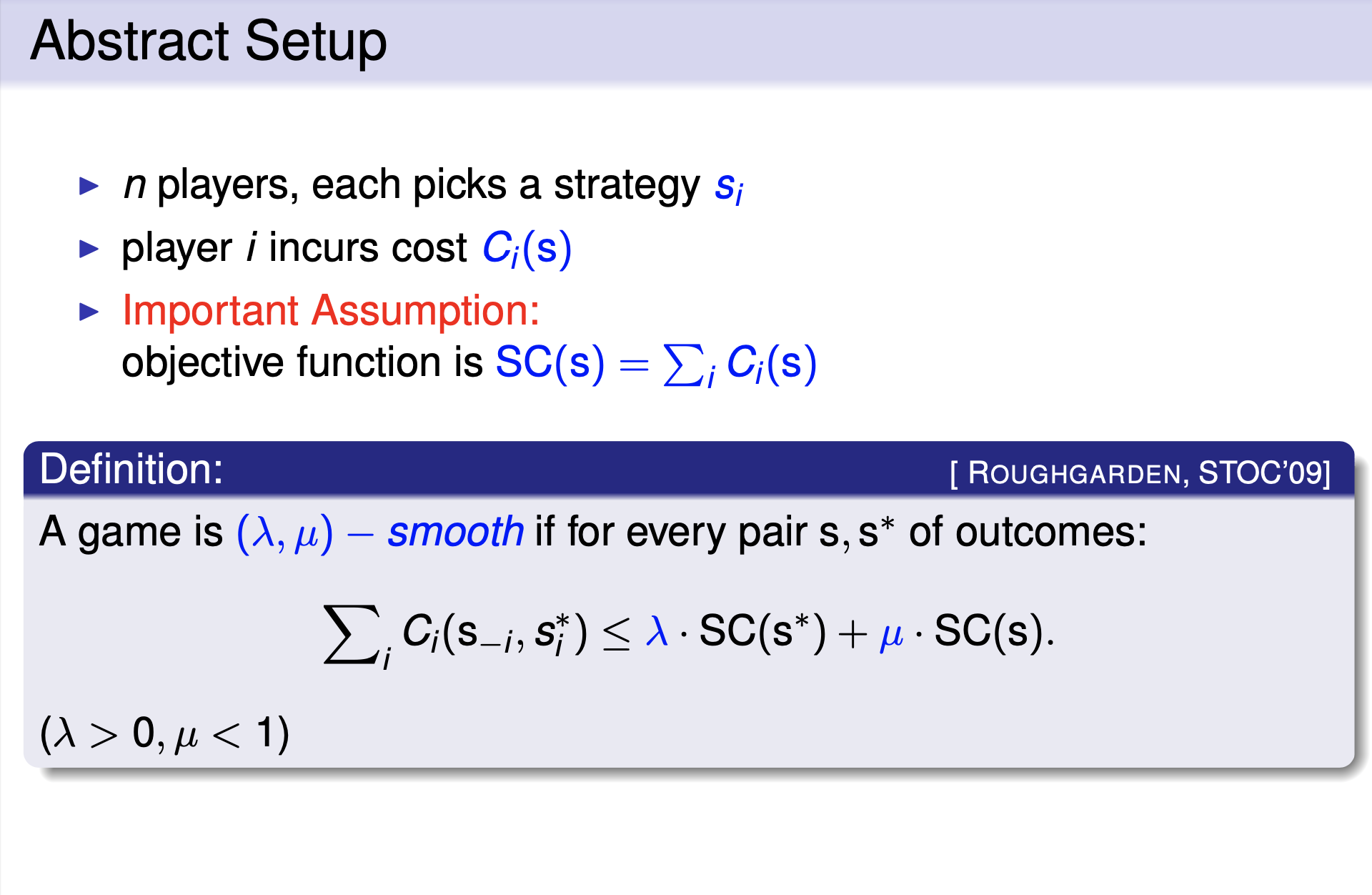
Abstract Setup 抽象系统