Formal
Algorithm
Common
Docker
Javascript
Network
Node
Notes
c++
c++Lib
golang
Javascript
Webpack
Vite
Webassembly
MCU
Protocol
ML
Compilation
DataStructure
Algorithm
MC_MP_Programming
ResearchMethod
PrivacySecurity
EfficientAlgorithm
AdvancedAlgorithmicTech
AlgorithmGameTheory
LowCodeProject
ComputerCompose
Network
LinearMath
OperationSystem
Mathmatic
Combinatorial Auctions (1)
Single Item Auction
- Goal: Give the object to the player with maximum value.
- In a way that cannot be strategically manipulated
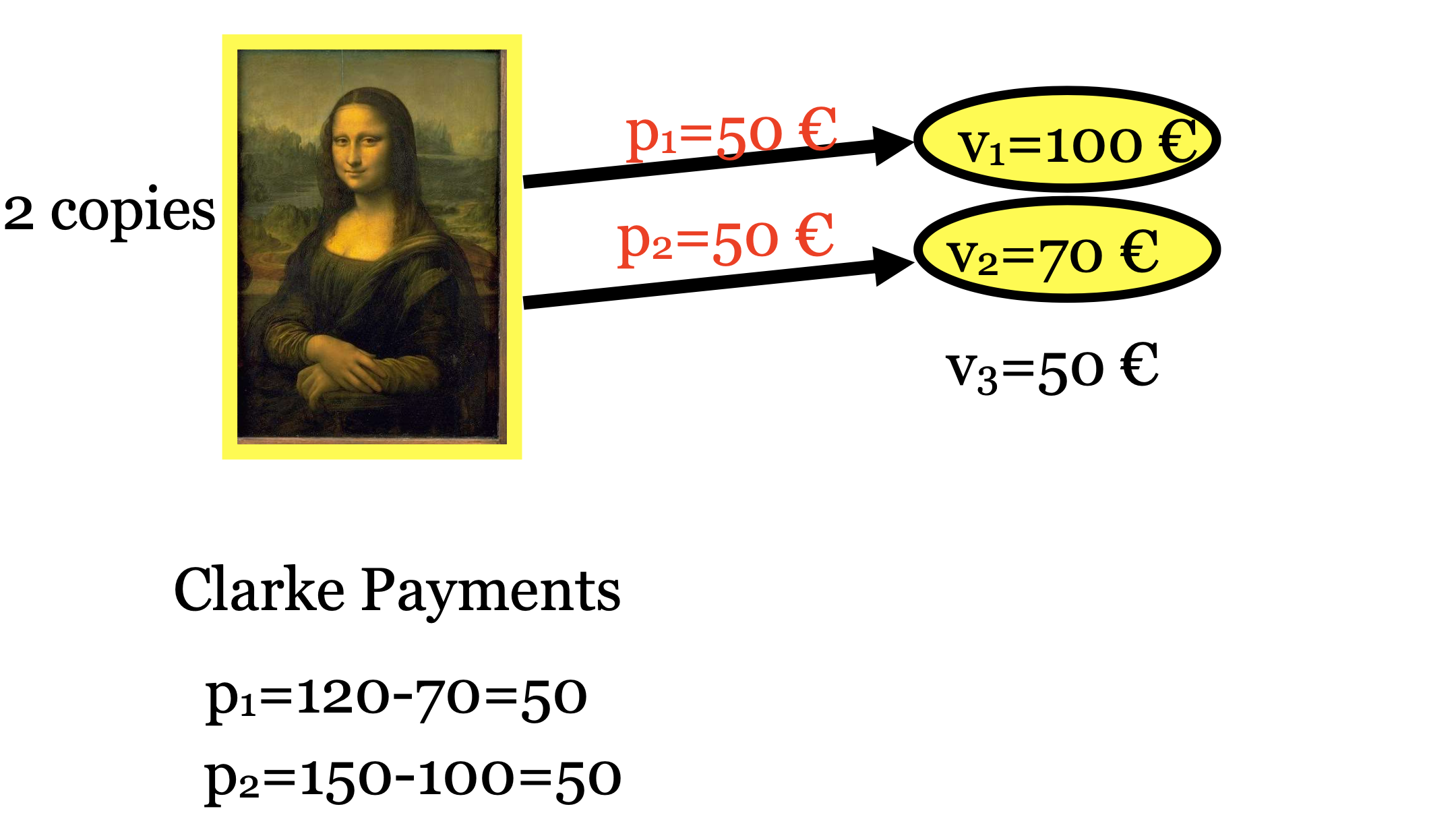
Multiunit Auctions
-
Definition:
-
Allocation Algorithm: Give the k objects to the k highest bidders.
-
Payment Scheme: The winners pay an amount equal to the k+1st highest bid.
-

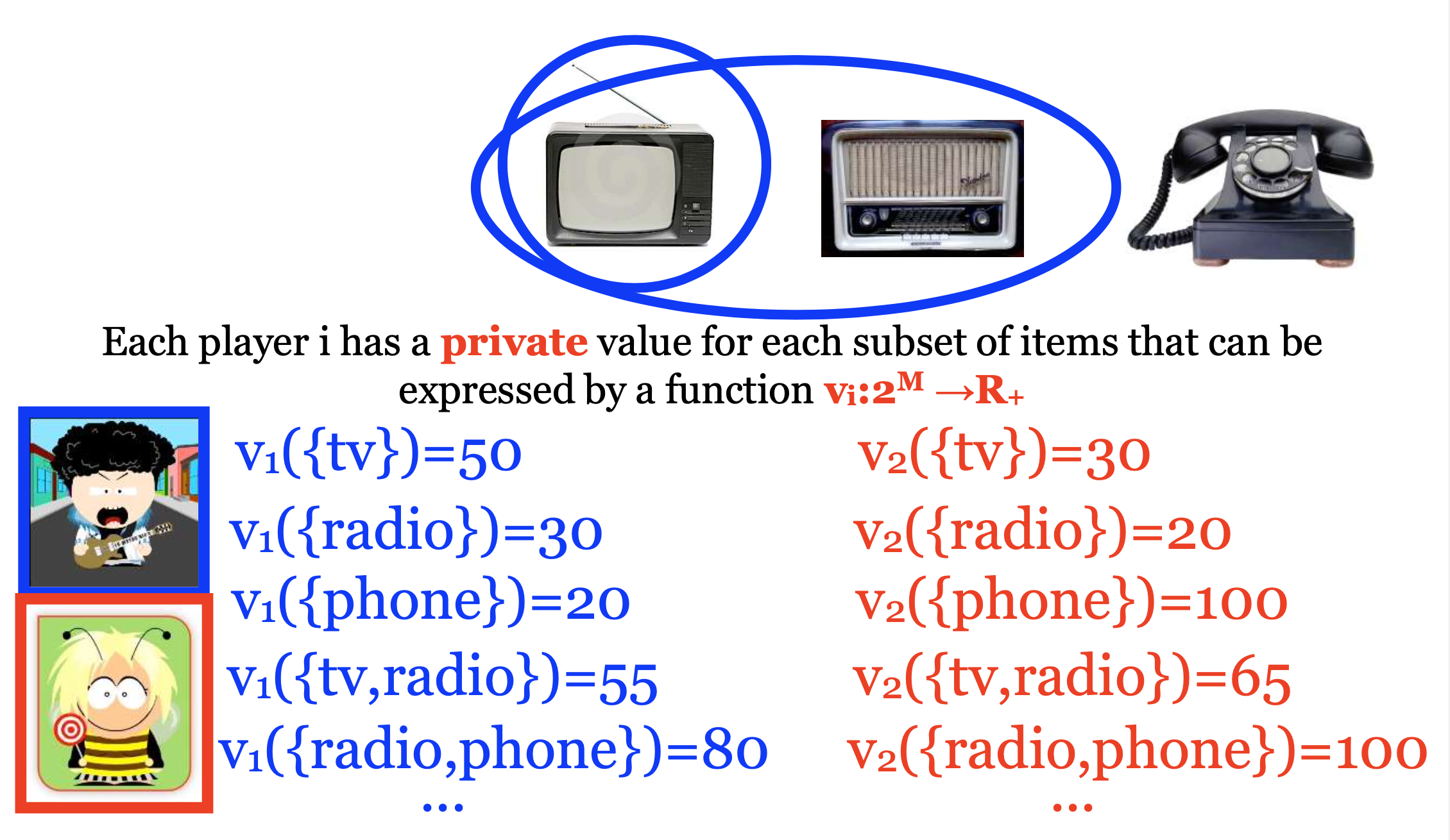
Example Combinatorial Valuations
-
Problem Statement
-
A set M of m indivisible items M={1,…,m}
-
A set N of n bidders N={1,…,n}
-
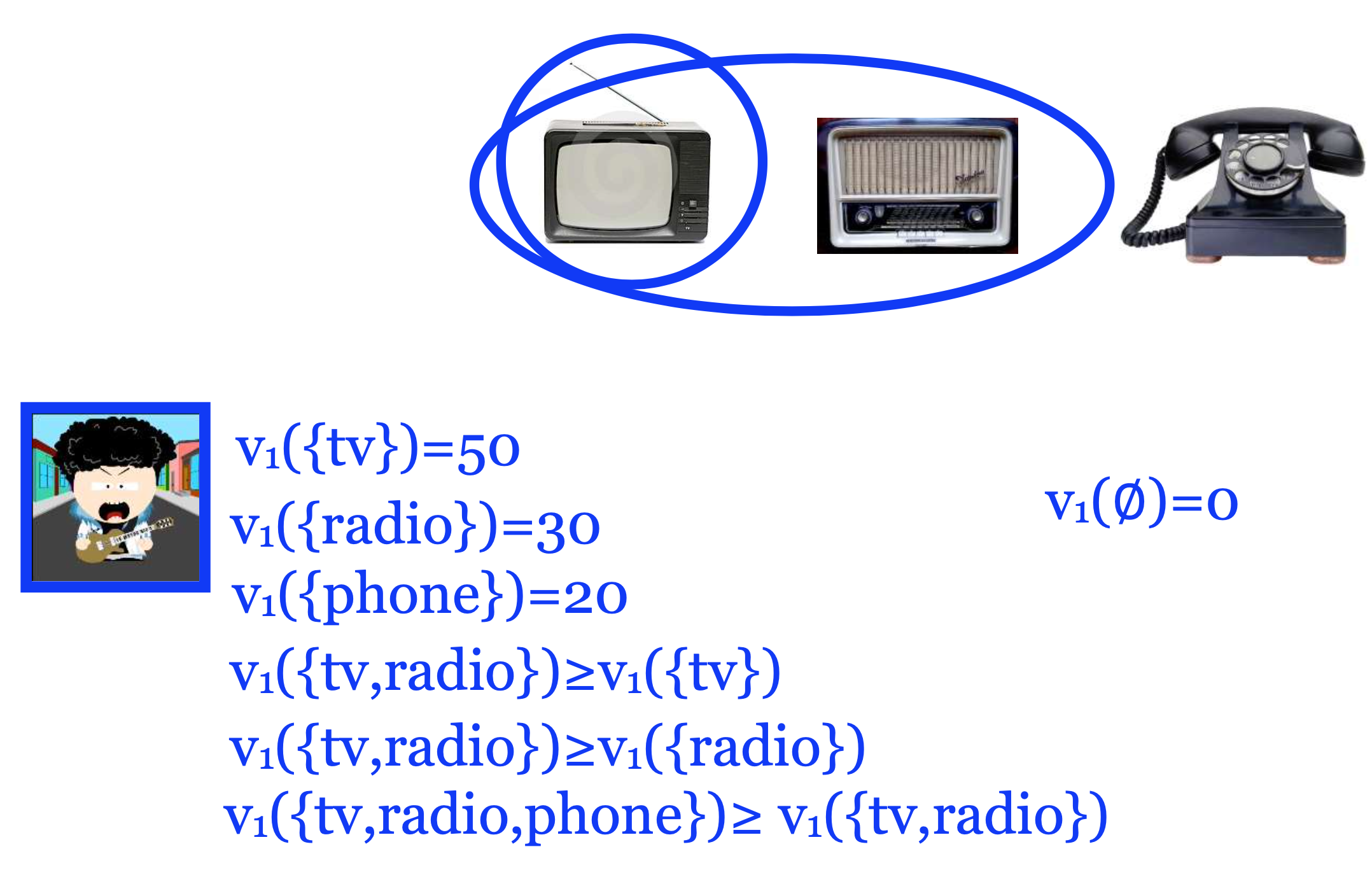
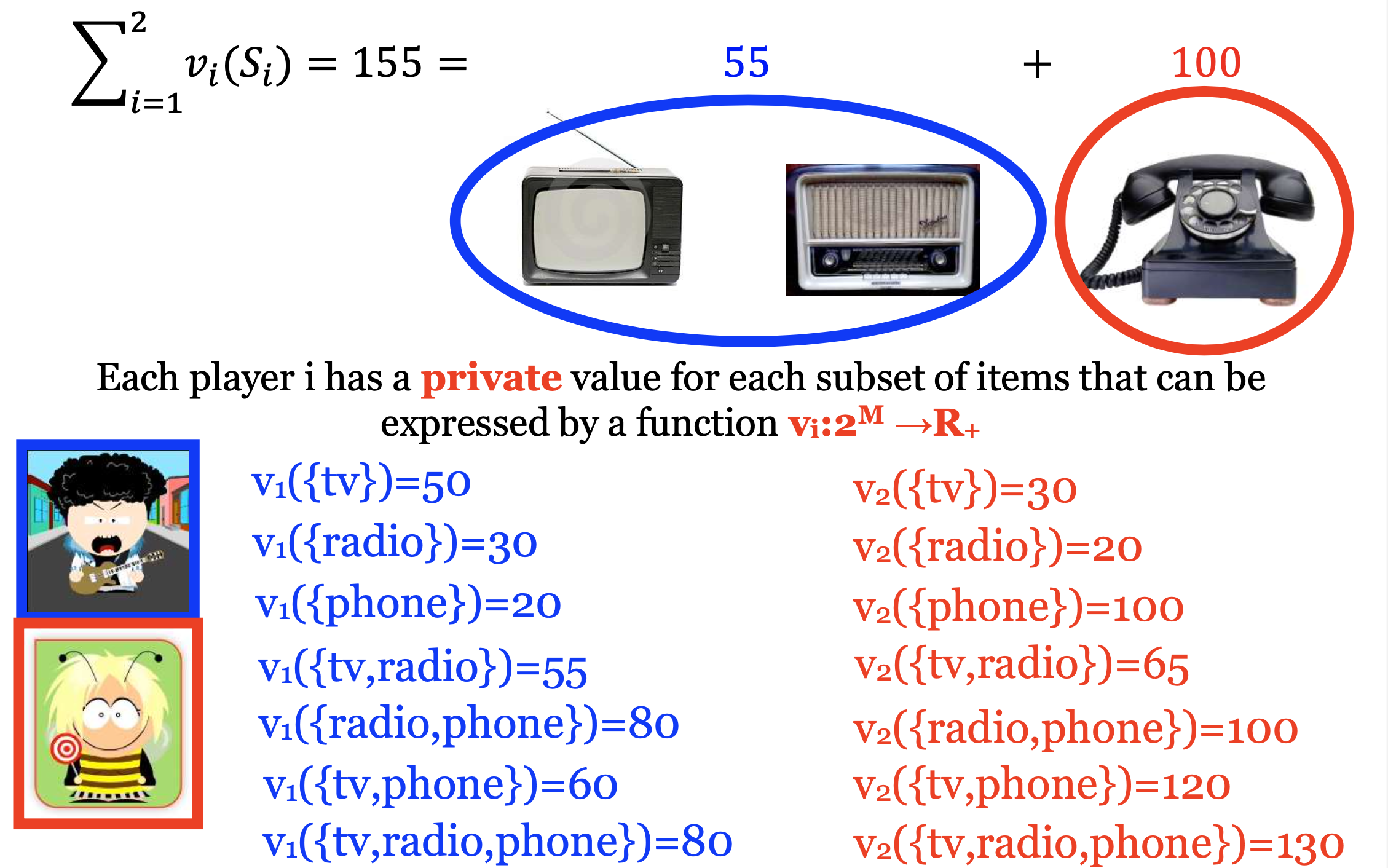
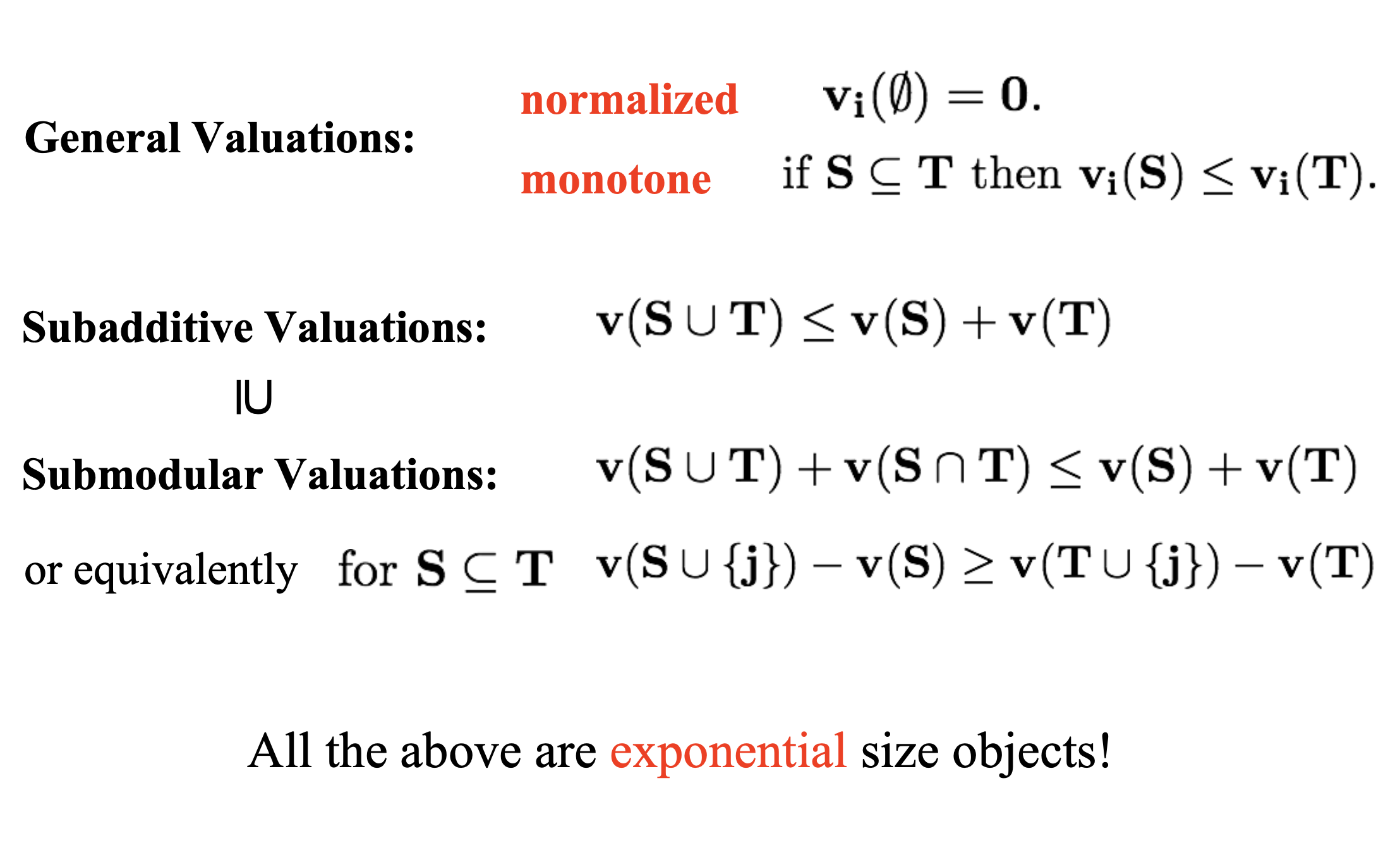
Bidders have preferences over subsets (bundles) of items A valuation is a real valued function for every subset S of items v(S) is the value the bidder obtains if he receives the bundle S
-
free disposal: monotone v(S)≤v(T) if S⊆T
-
normalized: v(∅)=0
-
-
Example
Roberts Theorem
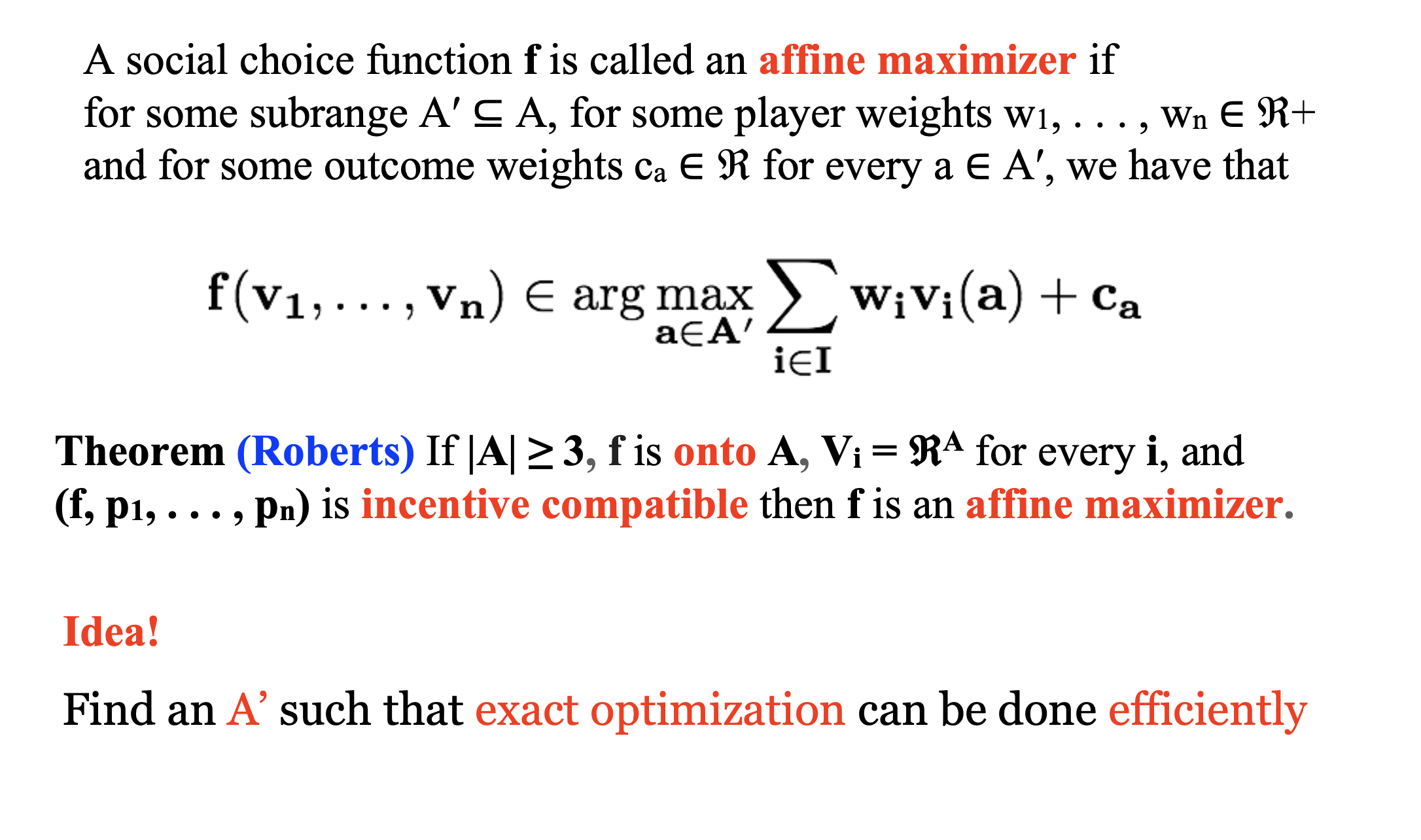
- Theorem (Roberts) If |A| ≥ 3, f is onto A, Vi = RA for every i, and (f, p1, . . . , pn) is incentive compatible then f is an affine maximizer.
Valuations
Take S,T with S∩T=∅
- v is additive if v(S∪T)=v(S)+v(T)
Generally, v is not necessarily additive
- S,T are Complements: v(S∪T) > v(S)+v(T) (Superadditive)
v(pair of shoes) > v(left shoe)+v(right shoe)
-S,T are Substitutes: v(S∪T) < v(S)+v(T) (Subadditive) v({margarine,butter}) < v(margarine)+v(butter)
E.g. Multiunit Auctions (Unit demand valuation)
Utility
-
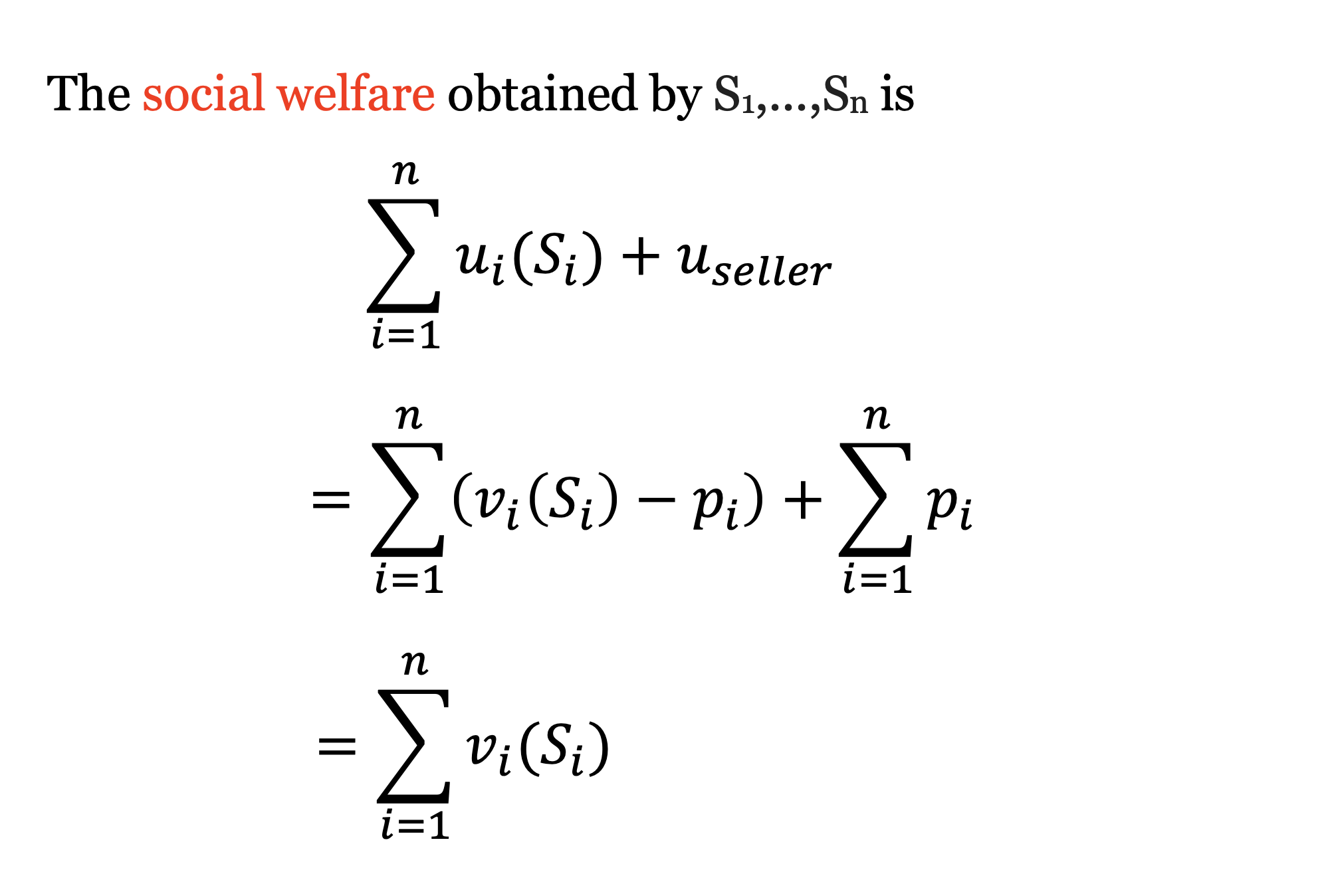
The utility is v(S)-p
-
No externalities: the bidder cares only about the set of items he receives and not about how the rest of the items are allocated
Allocation
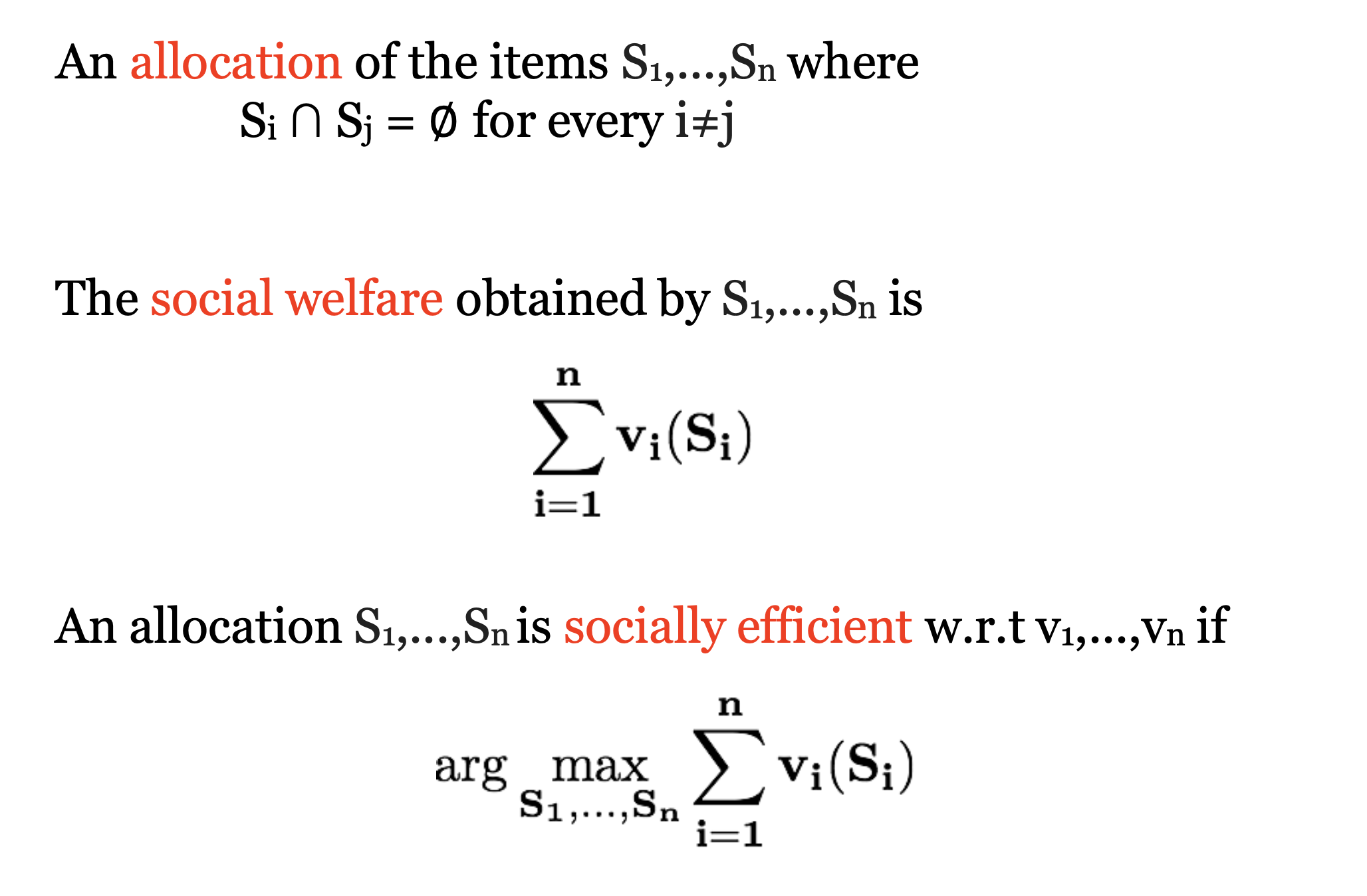
Social Welfare in Auctions
- Example – Maximize SW
-
Goals
-
Maximize social welfare
-
Maximize revenue
-
Minimize envy
-
-
Challenges
- Computational Complexity:
- The allocation problem is computationally hard even for special cases.
- How do we handle this?
- Representation and Communication:
-
The valuation functions are exponential size objects. •How can we even represent them?
-
How can we transfer enough information to the auctioneer so that a reasonable allocation can be found?
- Strategies:
- Can we design incentive-compatible mechanisms?
-
Applications
-
Spectrum Auctions: Government sells licences/rights to transmit signals of specific electromagnetic wavelengths
-
Transportation: “Reverse” or procurement auction.
-
A commercial company (buyer) needs to buy transportation services for a large number of routes from various transportation providers (sellers).
-
Each supplier has a value for every bundle of routes.
-
Single-Minded Bidders
-
Definition
-
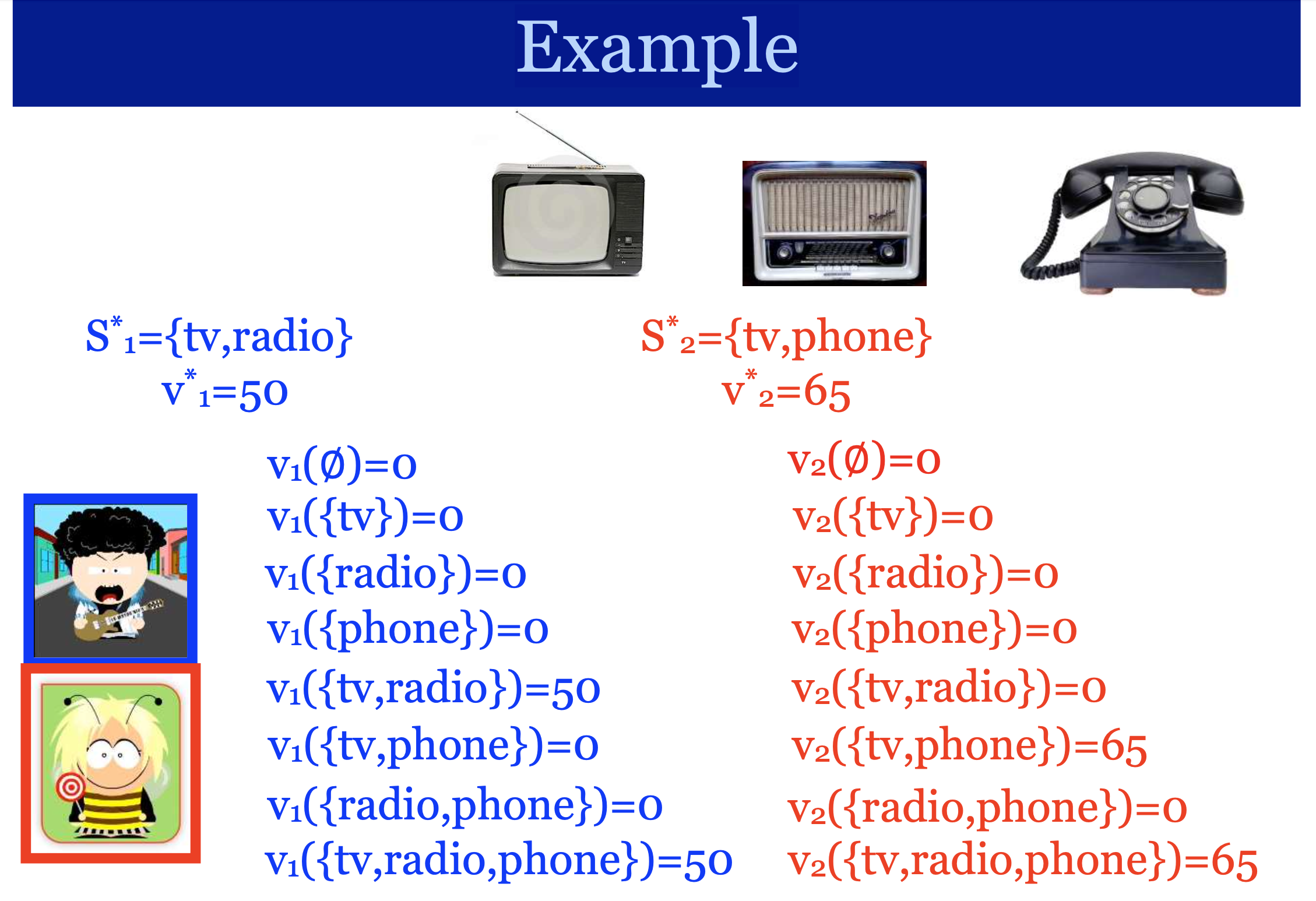
A valuation v is called single-minded if there exists a bundle of items S∗ and a value v∗ ∈ R+ such that v(S) = v∗ for all S ⊇ S∗, and v(S) = 0 for all other S.
-
A single-minded bid is the pair (S∗, v∗).
-
-
Example
- Known valuations
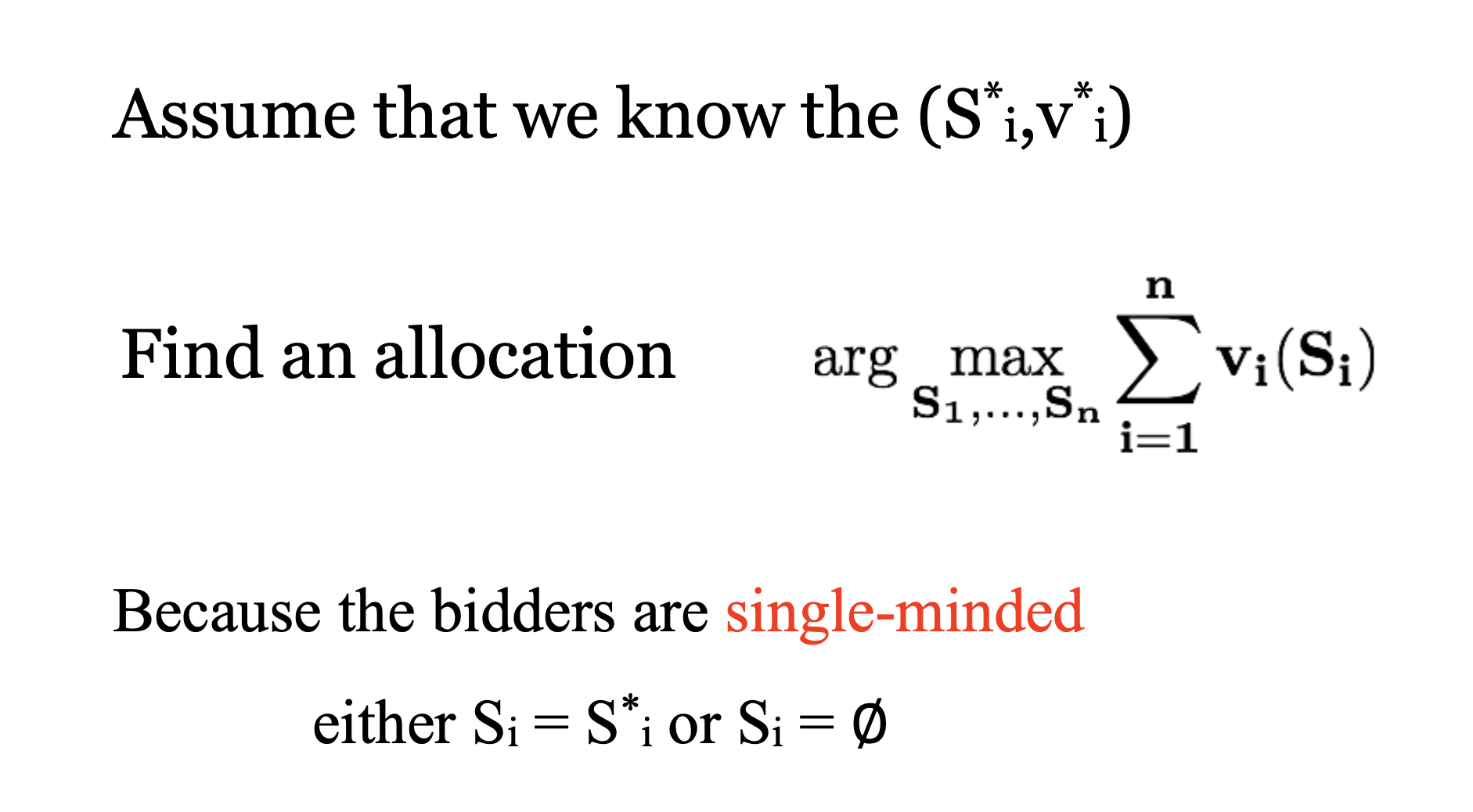
- The allocation problem
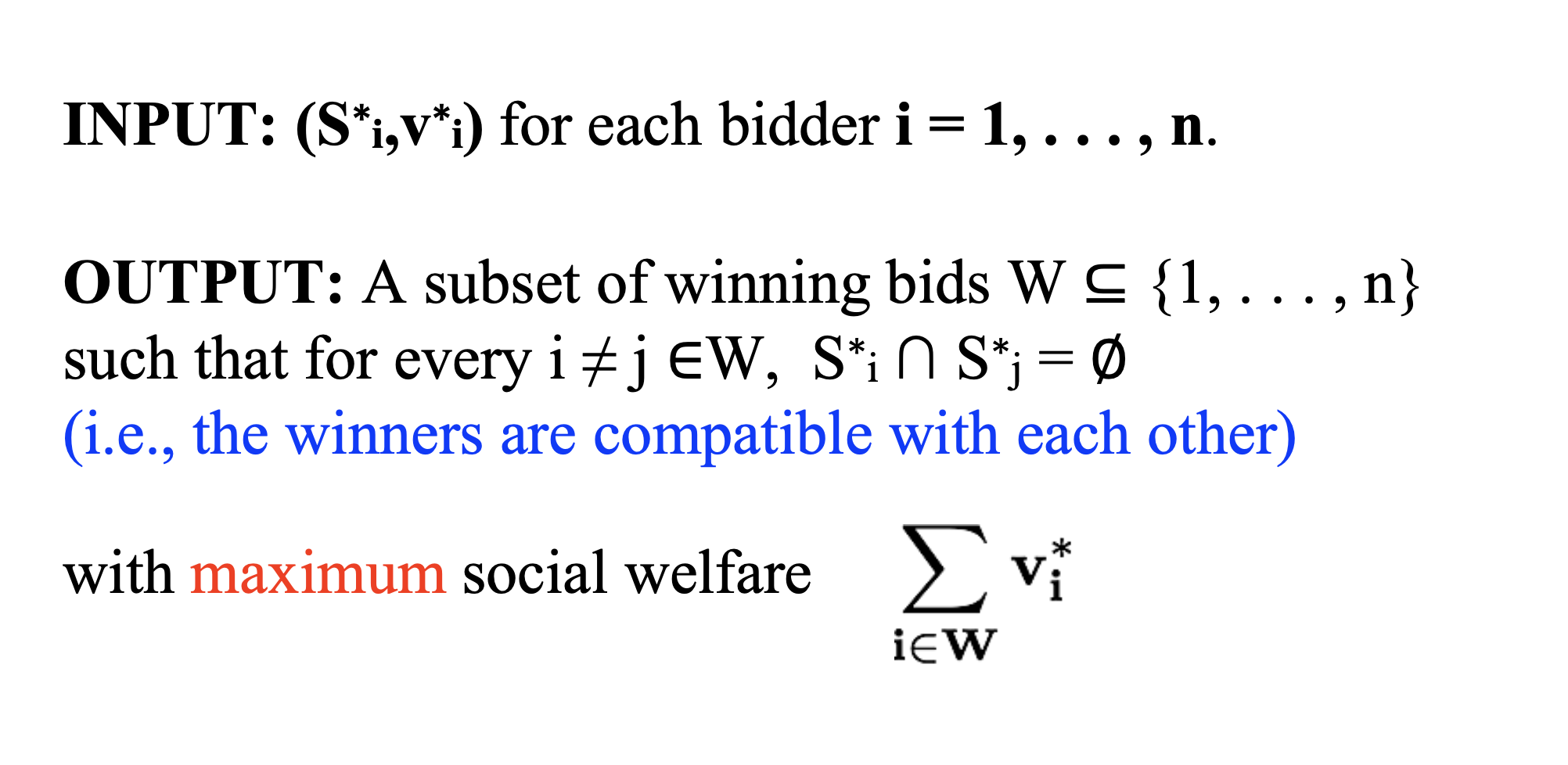
Computational Complexity
-
Proposition. The allocation problem among single-minded bidders is NP-hard.
-
More precisely, the decision problem of whether the optimal allocation has social welfare of at least k (where k is an additional part of the input) is NP-complete.
Approximation
-
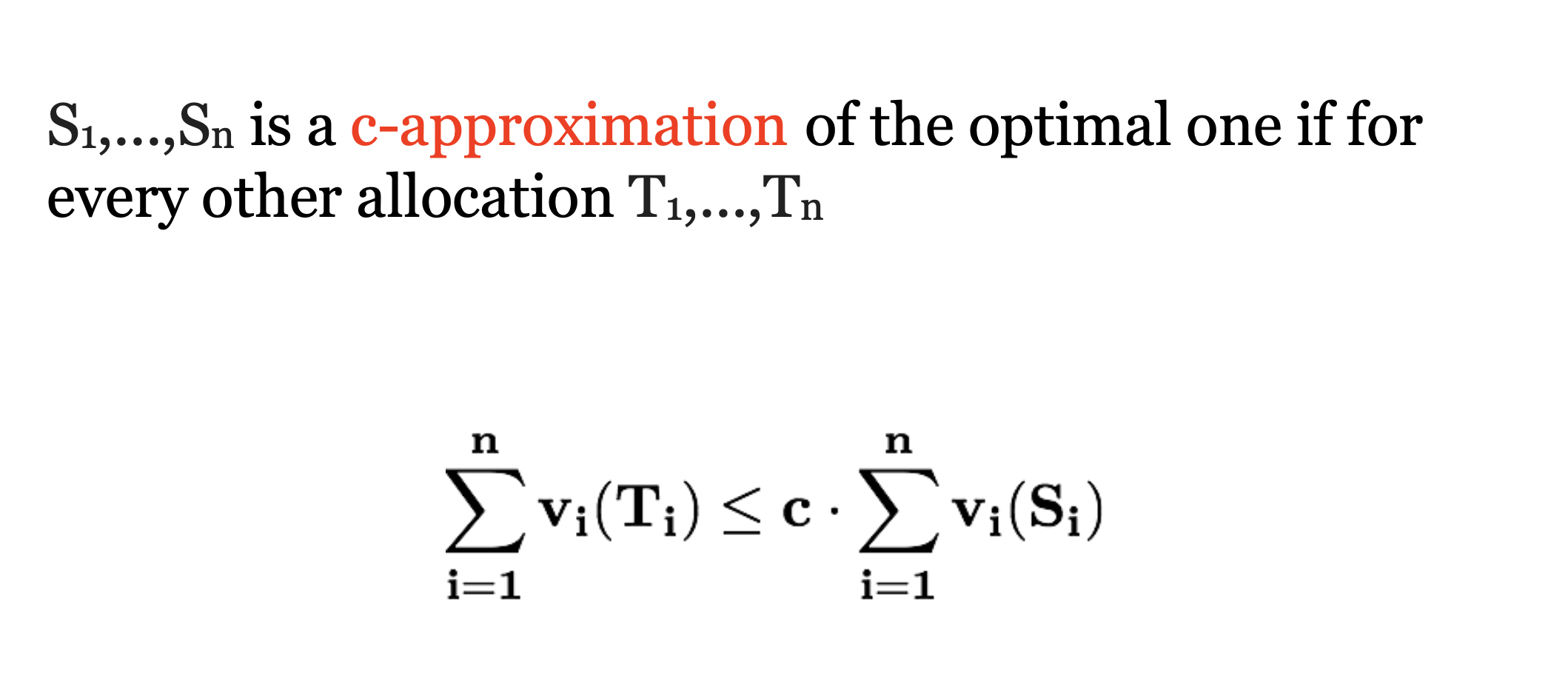
Approximate allocation (single-minded)
-
Proposition. Approximating the optimal allocation among single-minded bidders to within a factor better than m^1/2−ε is NP-hard.
-
Running the VCG may need exponential time!
-
Even if we knew the valuations, we couldn’t be able to approximate the optimum social welfare by a factor better than m^1/2−ε in polynomial time.
Incentive-Compatible Mechanism
-
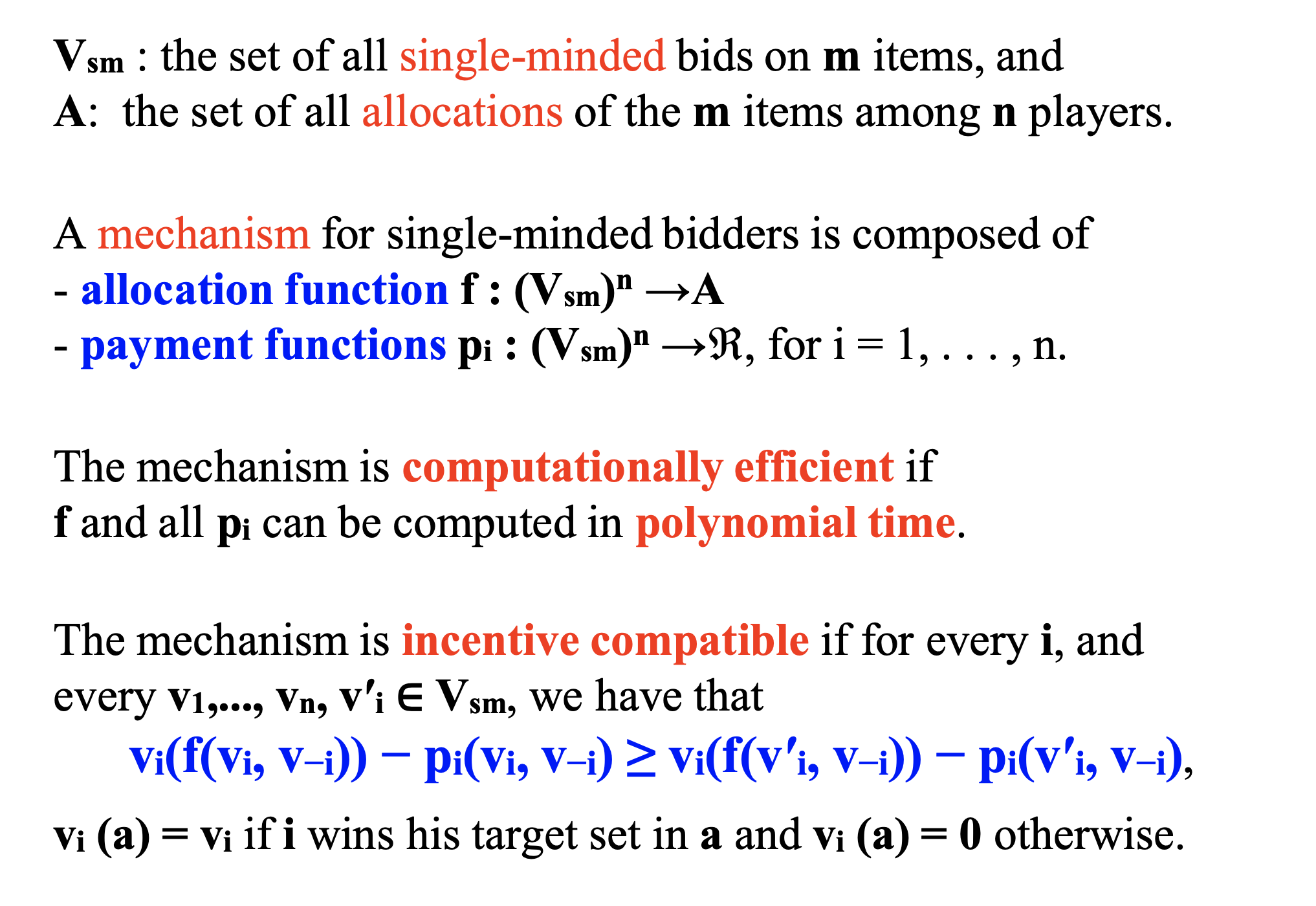
Compute the optimal allocation and charge VCG payments
This is incentive-compatible
Not computationally efficient
-
Take an approximate solution and charge VCG payments?
The VCG payments work only with exact optimization.
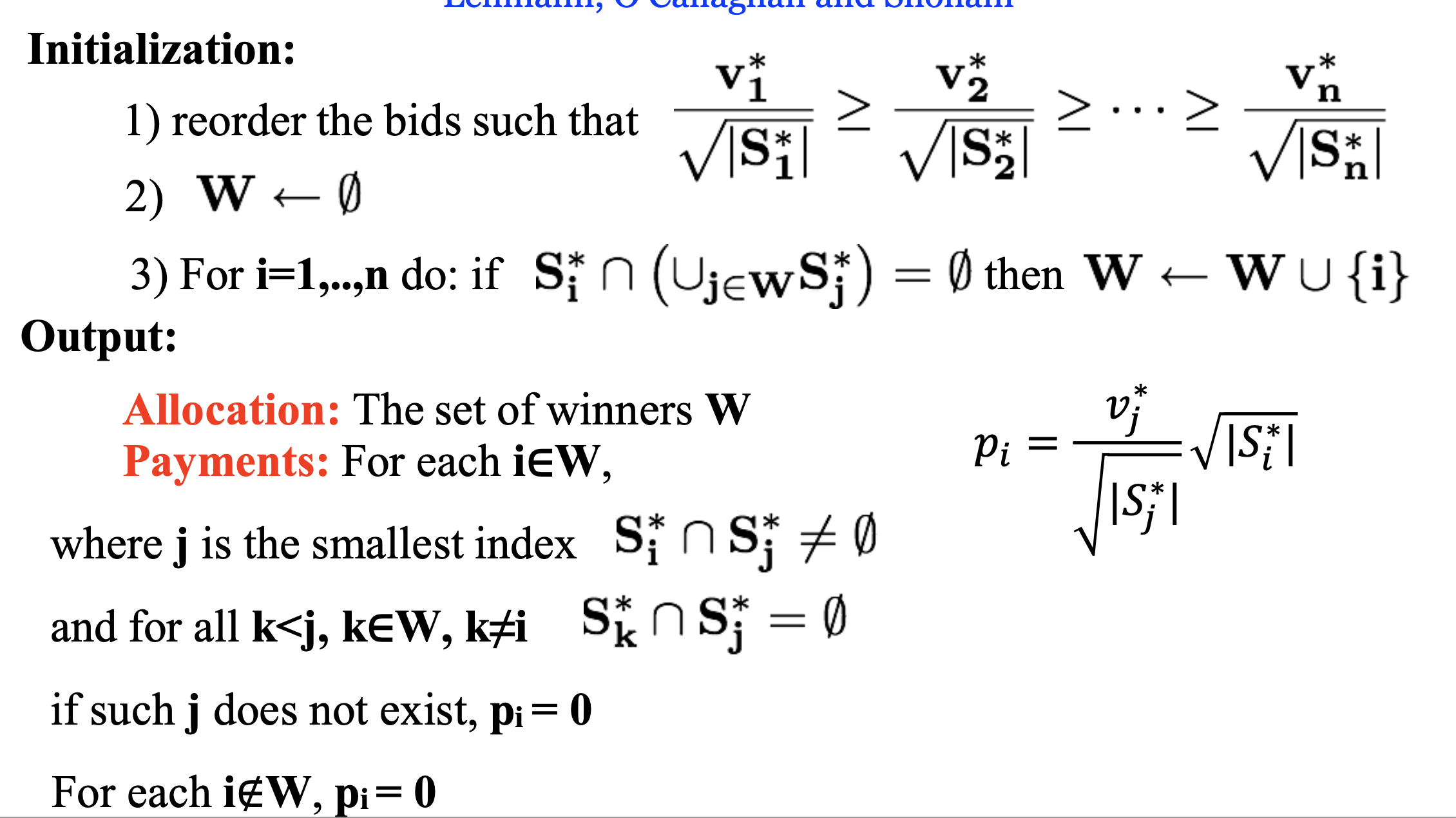
The Greedy Mechanism for Single-Minded Bidders
- Example
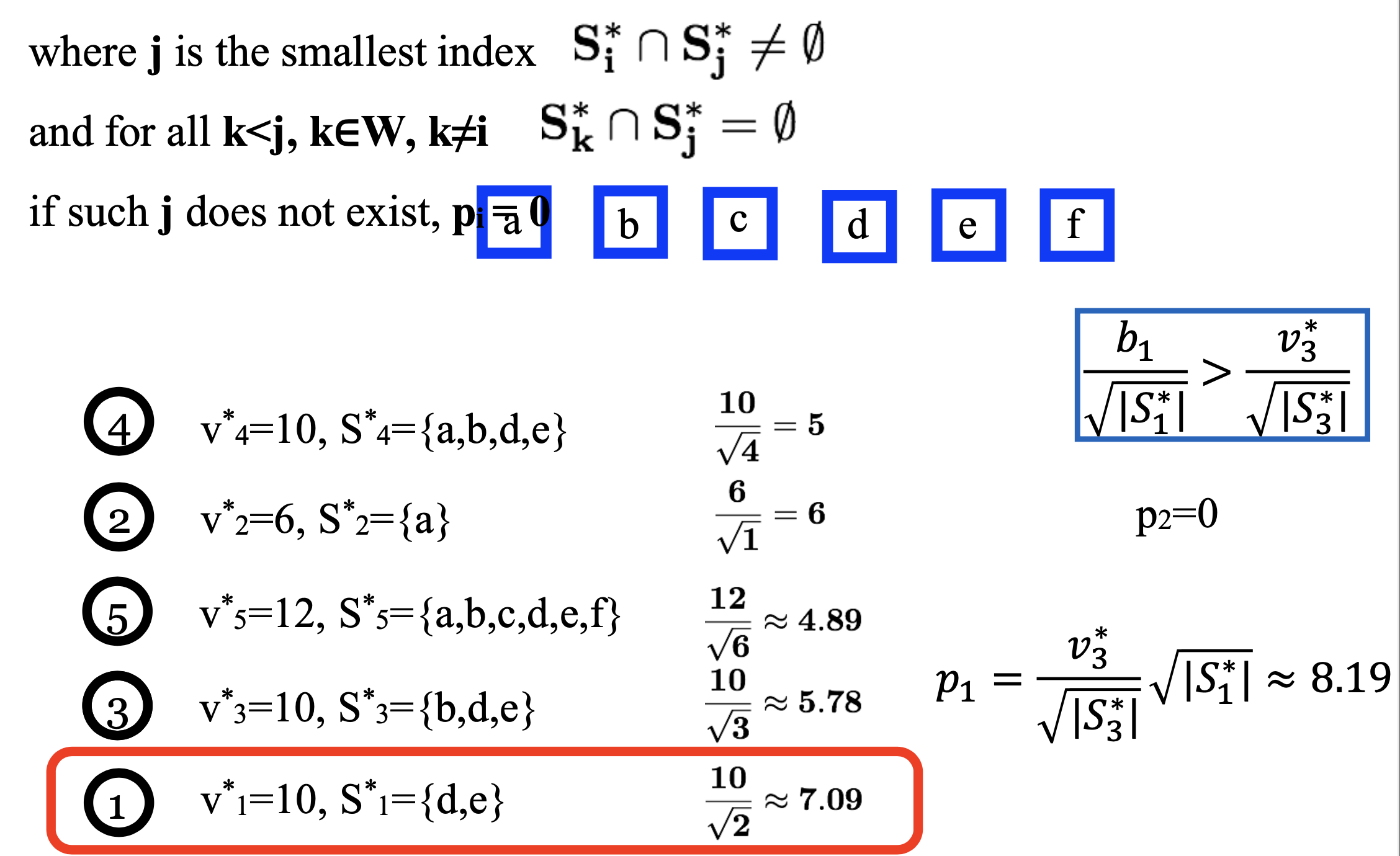
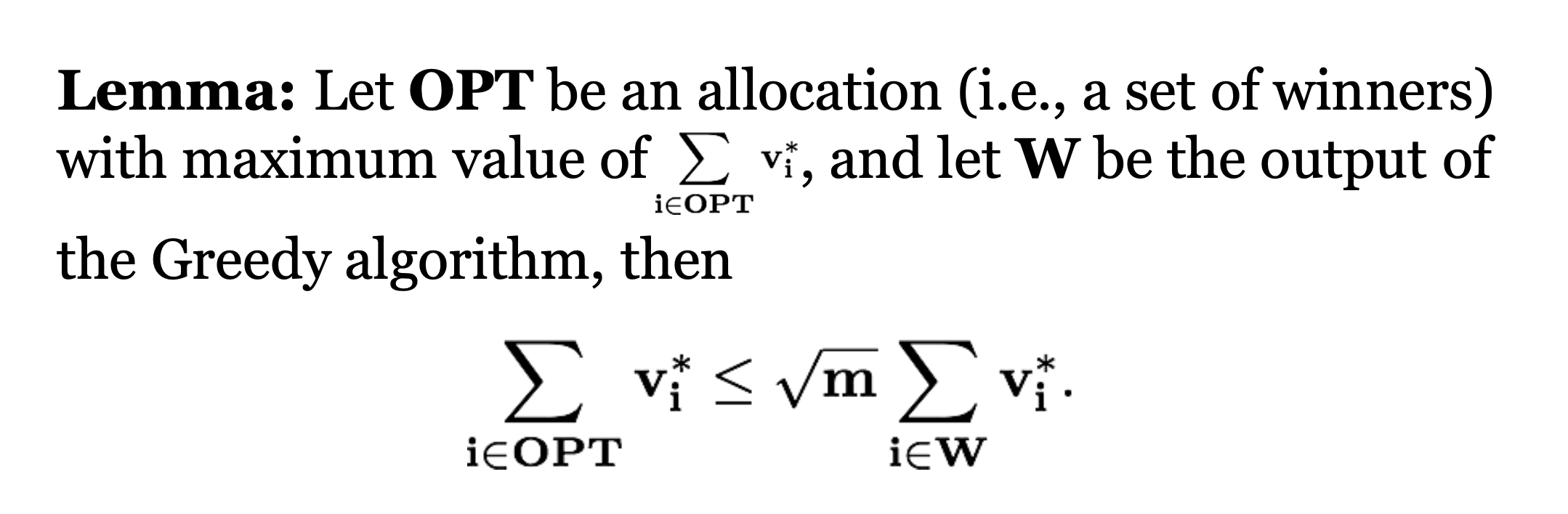
- Theorem. The Greedy mechanism is efficiently computable, incentive compatible and produces a m^1/2 approximation of the optimal social welfare.
Incentive Compatibility
-
Proof Outline
-
First, we will show that a larger class of mechanisms are truthful.
-
Then, we will show that Greedy belongs to this class, and therefore is truthful.
-
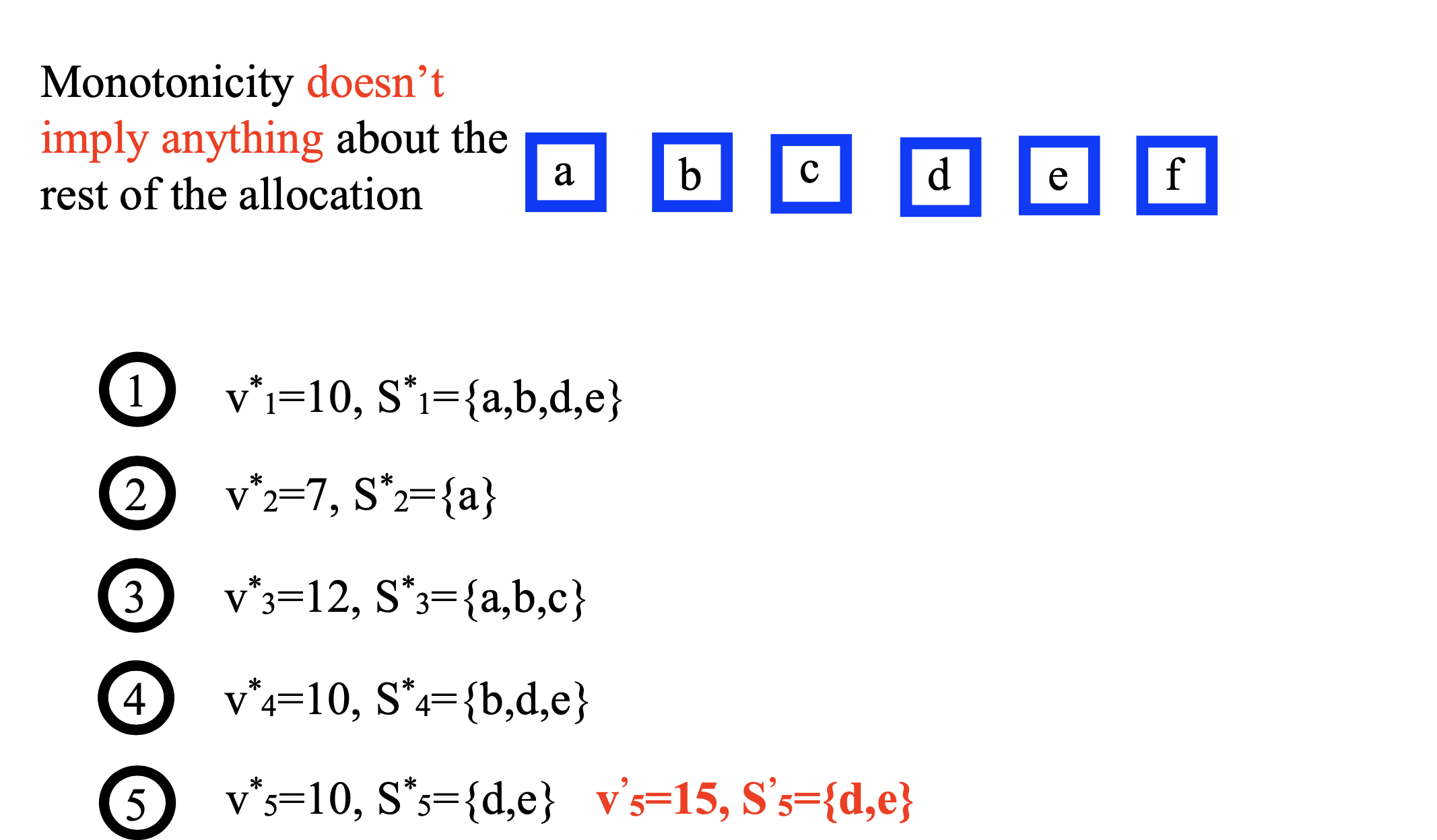
Monotonicity
-
A bidder who wins with bid (S∗i , v∗i) keeps winning for any v′i ≥v∗i andforanyS′i ⊆S∗i (for any fixed settings of the other bids).
-
Example:
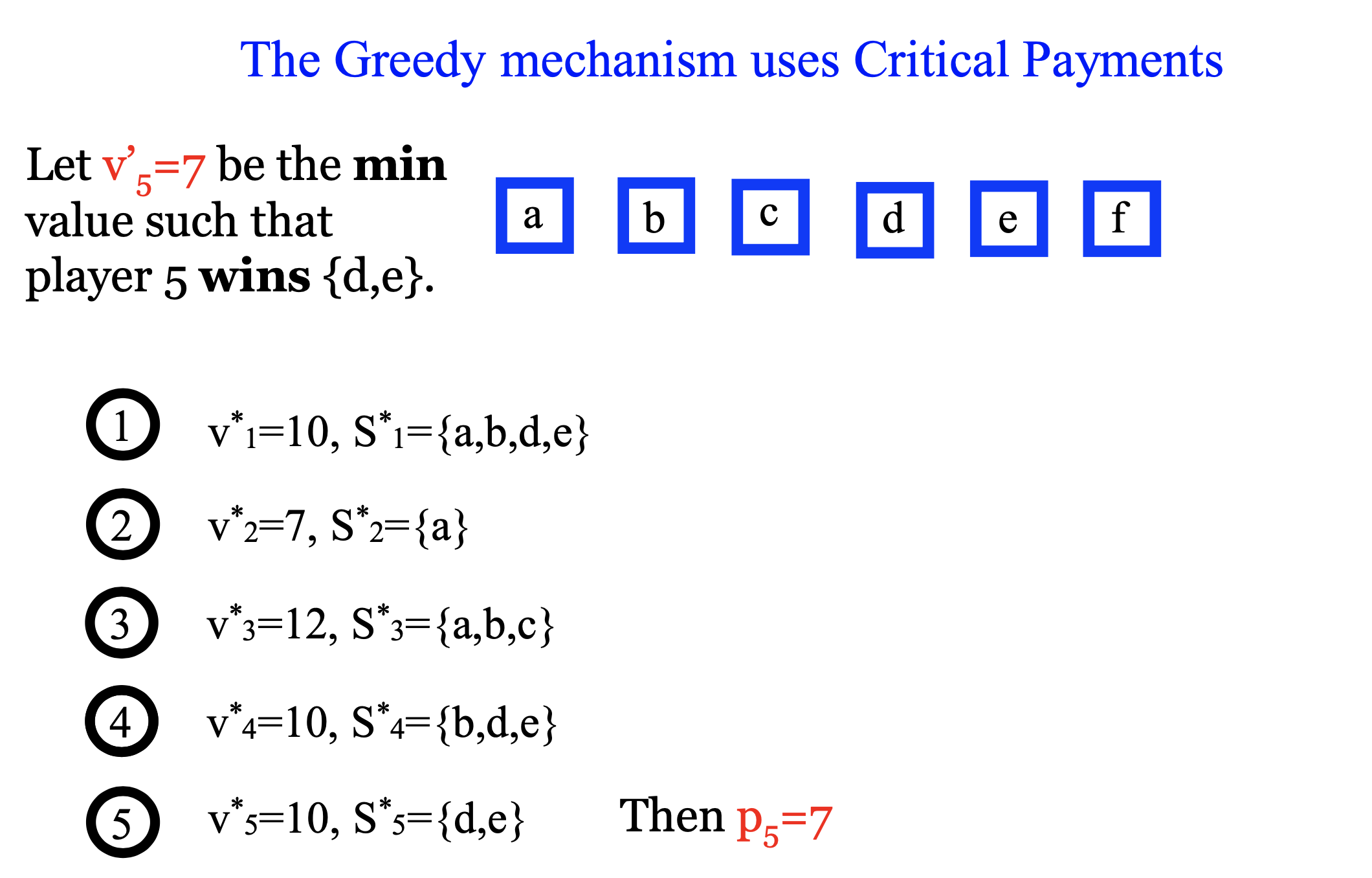
Critical Payments
-
Critical Payment: A bidder who wins pays the minimum value needed for winning: the infimum of all values v′i such that (S∗i , v′i ) still wins.
-
Example:
Incentive Compatibility
-
Lemma. A mechanism for single-minded bidders, in which losers pay 0, is incentive compatible if and only if it is Monotone and uses Critical Payment.
-
The Greedy is a mechanism for single-minded bidders, in which losers pay 0, and it is Monotone and uses Critical Payment. Therefore, it is incentive compatible.
Approximation
Part2
Other Valuations
Iterative Auctions
The Query Model
-
Indirect way of sending information about the valuations
-
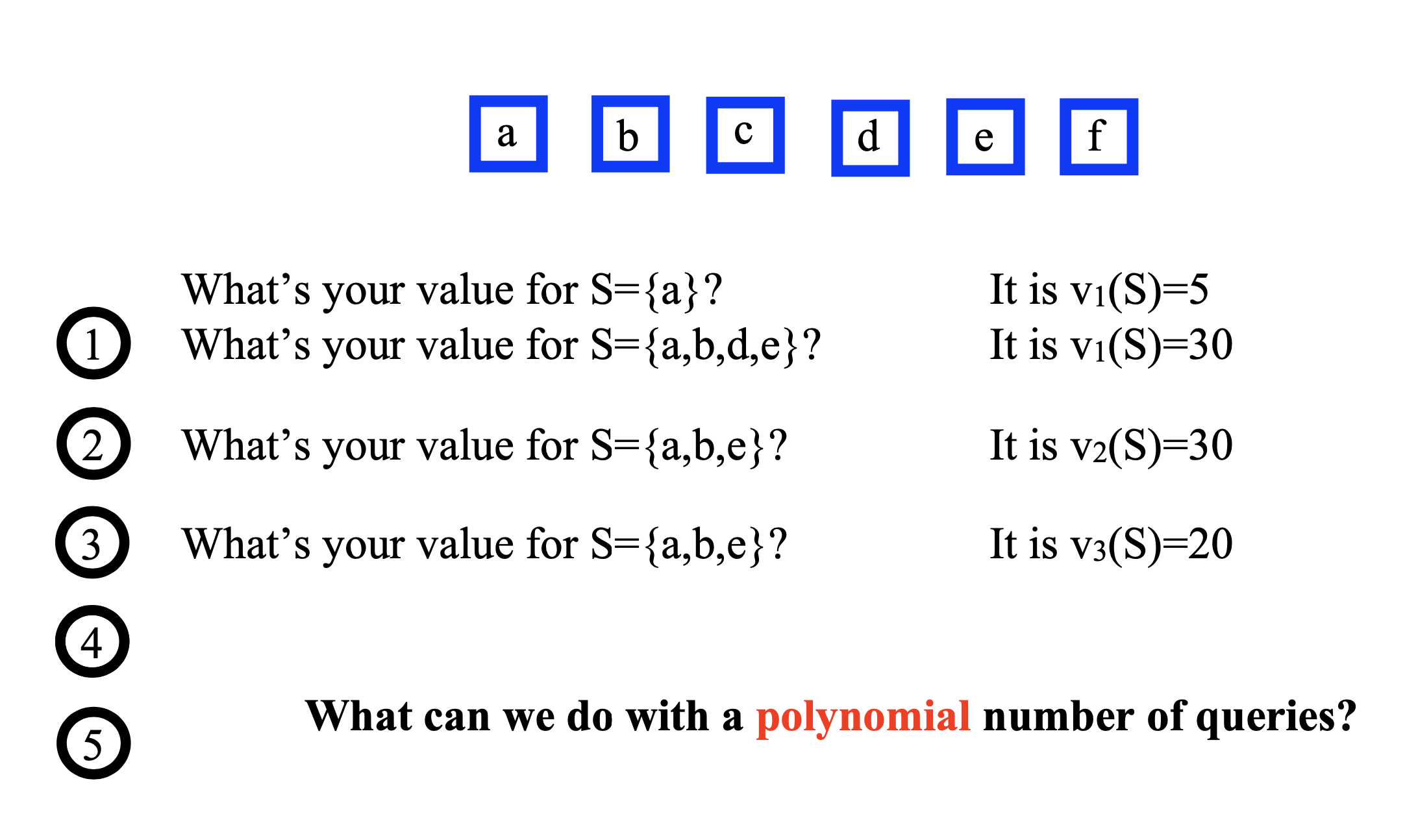
The auction protocol repeatedly interacts with the different bidders, aiming to adaptively elicit enough information about the bidders’ preferences as to be able to find a good (optimal or close to optimal) allocation.
Advantages
- Reduces the amount of information transferred
- Preserve some privacy about the valuations
- Makes bidder’s life easier (concentrates on the mechanisms queries) Bidder is a “Black-Box” represented by an oracle
Query Model
- The auctioneer presents a bundle S, the bidder reports his value v(S) for this bundle.
Subadditive Valuations
-
v(S U T) <= v(S) + v(T)
-
Can we design incentive compatible mechanisms that approximate the optimal social welfare?
Affine Maximizers
-
Example 1
A’={all the assignments that assign only the first item to a player} Optimize over A’, charge the VCG payments.
- It is incentive compatible as an affine maximizer. - Poor approximation ratio.
a b {a, b} v1 ε 1 1 v2 ε 1 1 -
SW(ALG) = ε
-
SW(OPT) = 1+ε
-
Approximation ratio = SW(OPT)/SW(ALG) = (1+ε)/ε
-
Example 2
i1 i2 M v1 1 1 1 v2 1 1 1 vn 1 1 1 -
SW(ALG) = 1
-
SW(OPT) = n
-
Approximation ratio = SW(OPT)/SW(ALG) = n
-
-
Exact optimization in A’ gives good approximation for A
(DNS) Mechanism for SA valuations
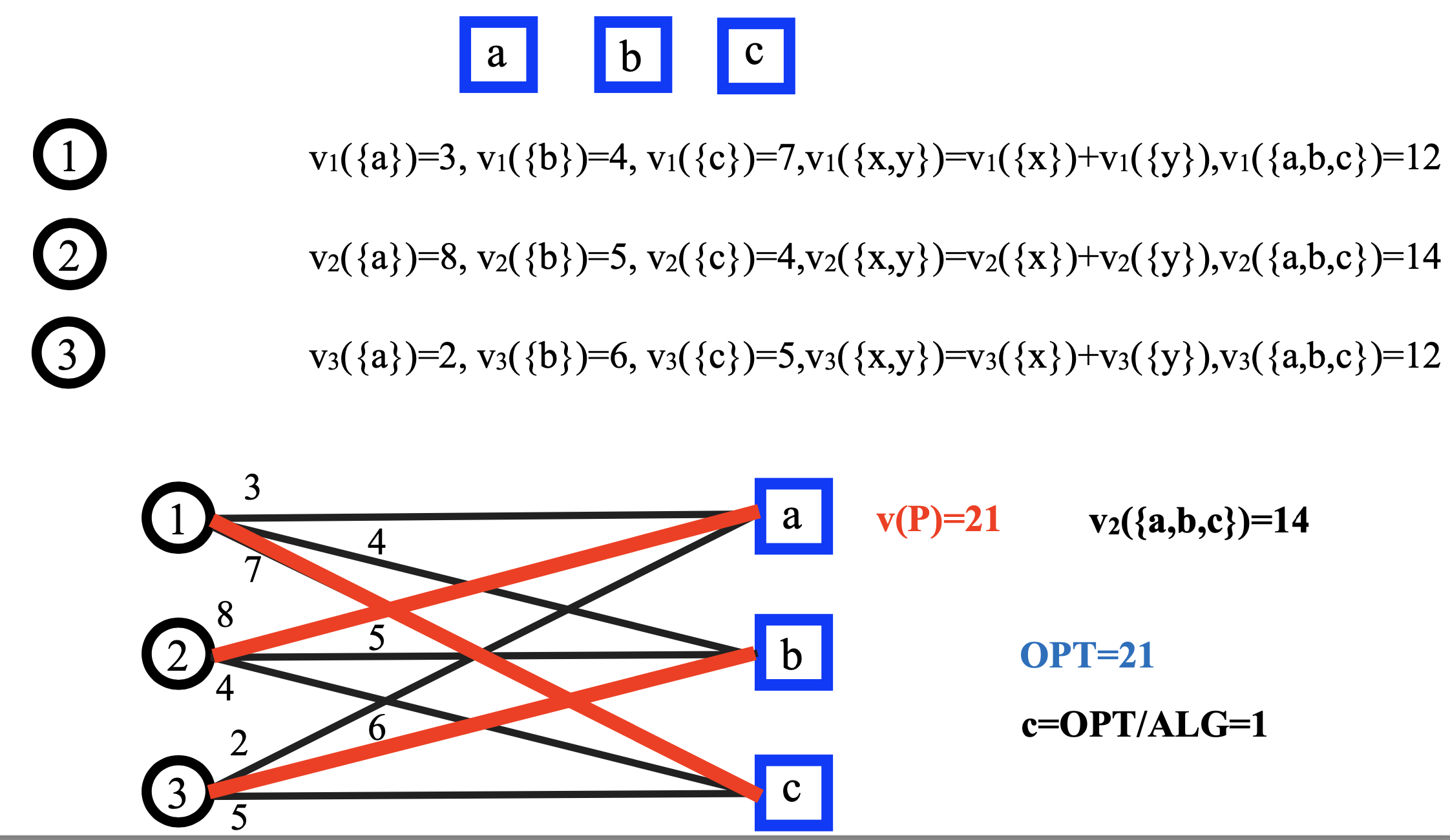
i) For each bidder i=1,…, n do:
-
Query bidder i for the set M={1,…,m}
-
For each item j=1,…,m do: Query bidder i for the item j
ii) Construct a bipartite graph G=(N,M,E)
-
a vertex bi for every player i 2) a vertex aj for every item j
-
E=(bi,aj)
-
w(bi,aj)=vi(j)
iii) Compute a maximum weighted matching P of G
iv) Find the bidder i*∈ arg maxi vi(M)
v) Return the assignment with maximum S.W. among iii) and iv)
- example
- example 2
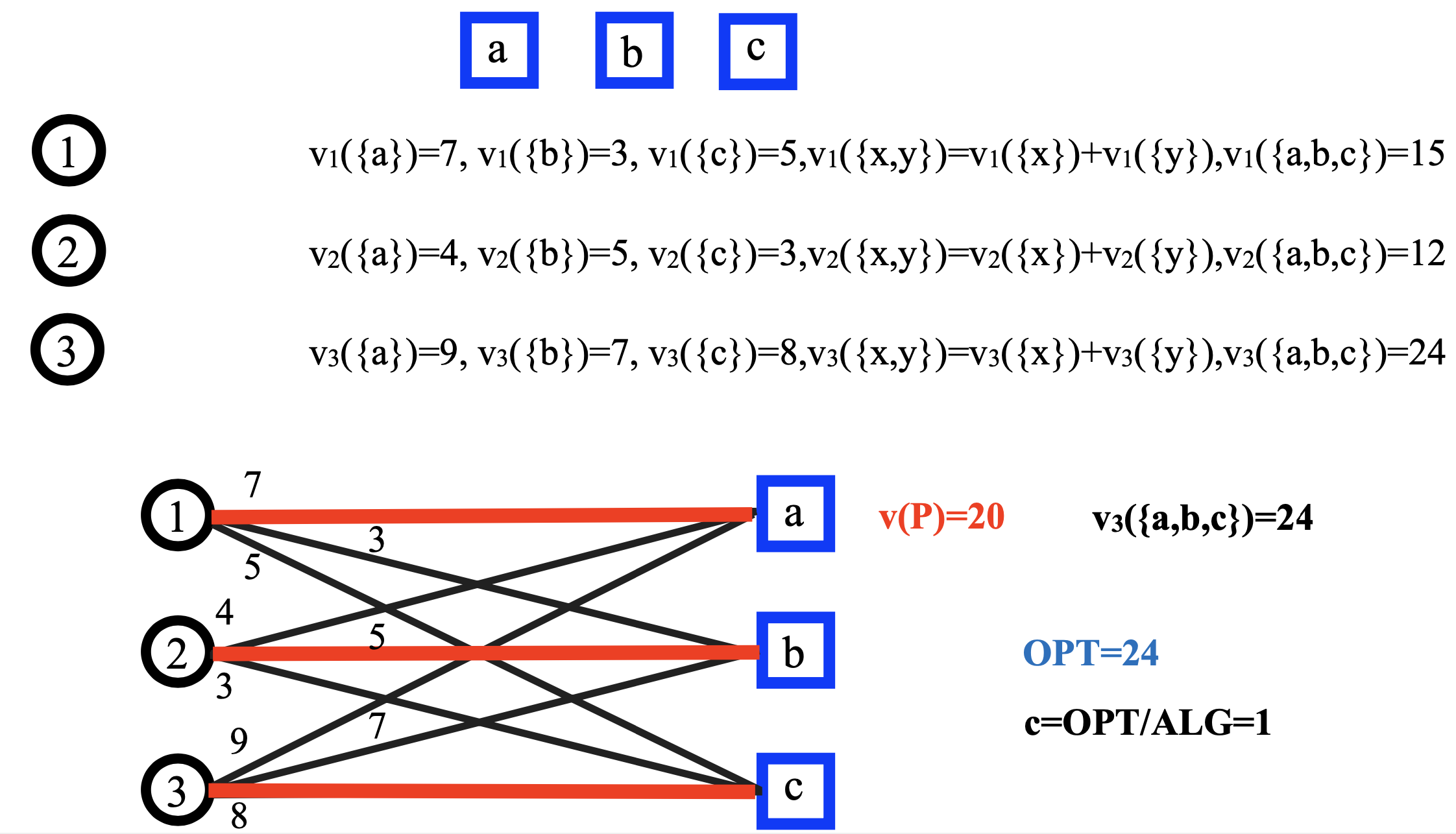
- example 3
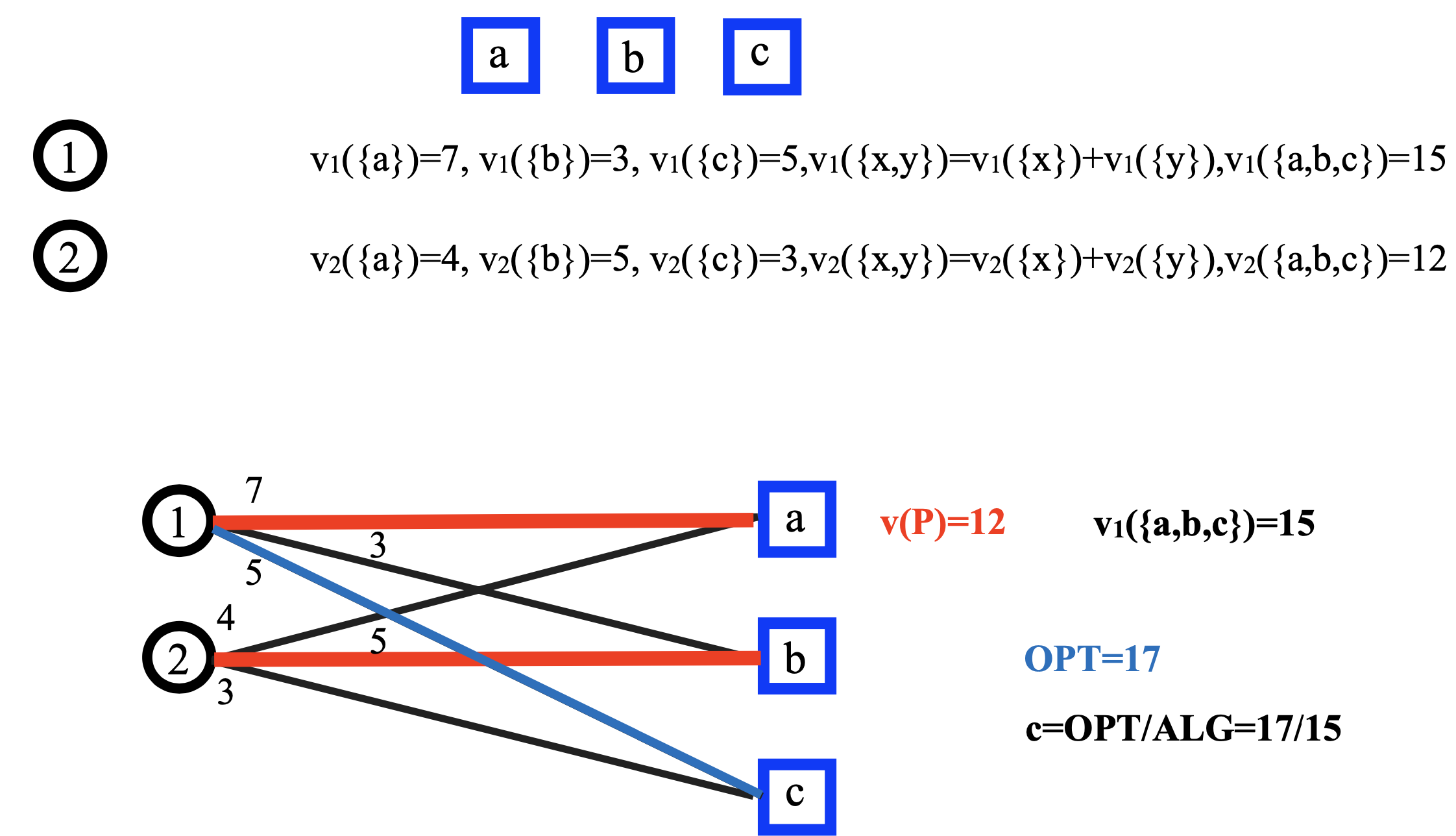
- Theorem. The DNS mechanism is efficiently computable, incentive compatible and produces a O(m1/2) approximation of the optimal social welfare for subadditive valuations.
Item Bidding Auctions
-
Item-bidding or simultaneous auctions
-
Bidders simultaneously submit a single bid for each item.
-
Each item is sold in a single-item auction.
-
First price item-bidding auction
-
Second price item-bidding auction - All-pay item-bidding auction
-
-
Efficient computation
-
Non-truthful mechanisms
-
-
Example

- Not Truthful
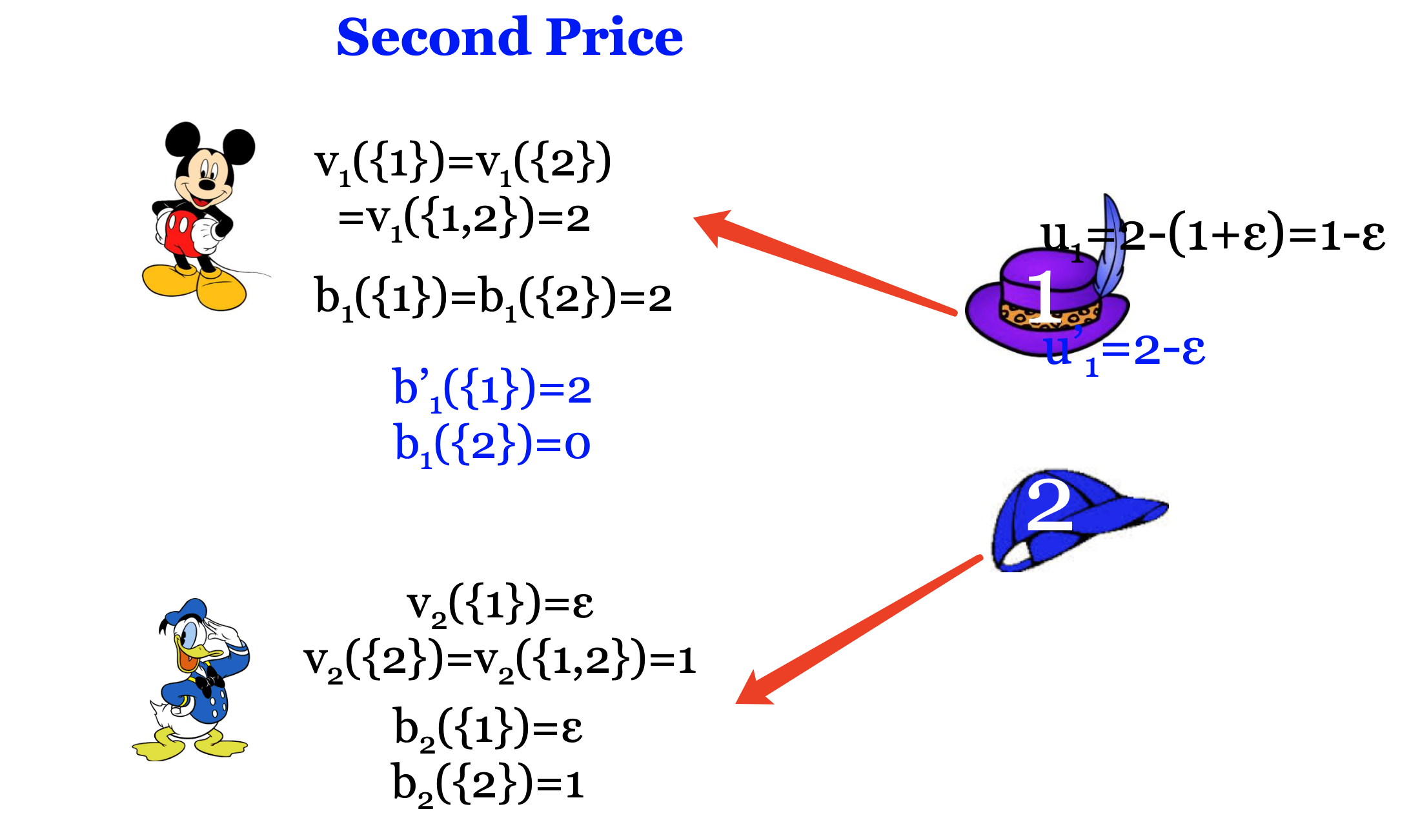
- PoA ≥ 2
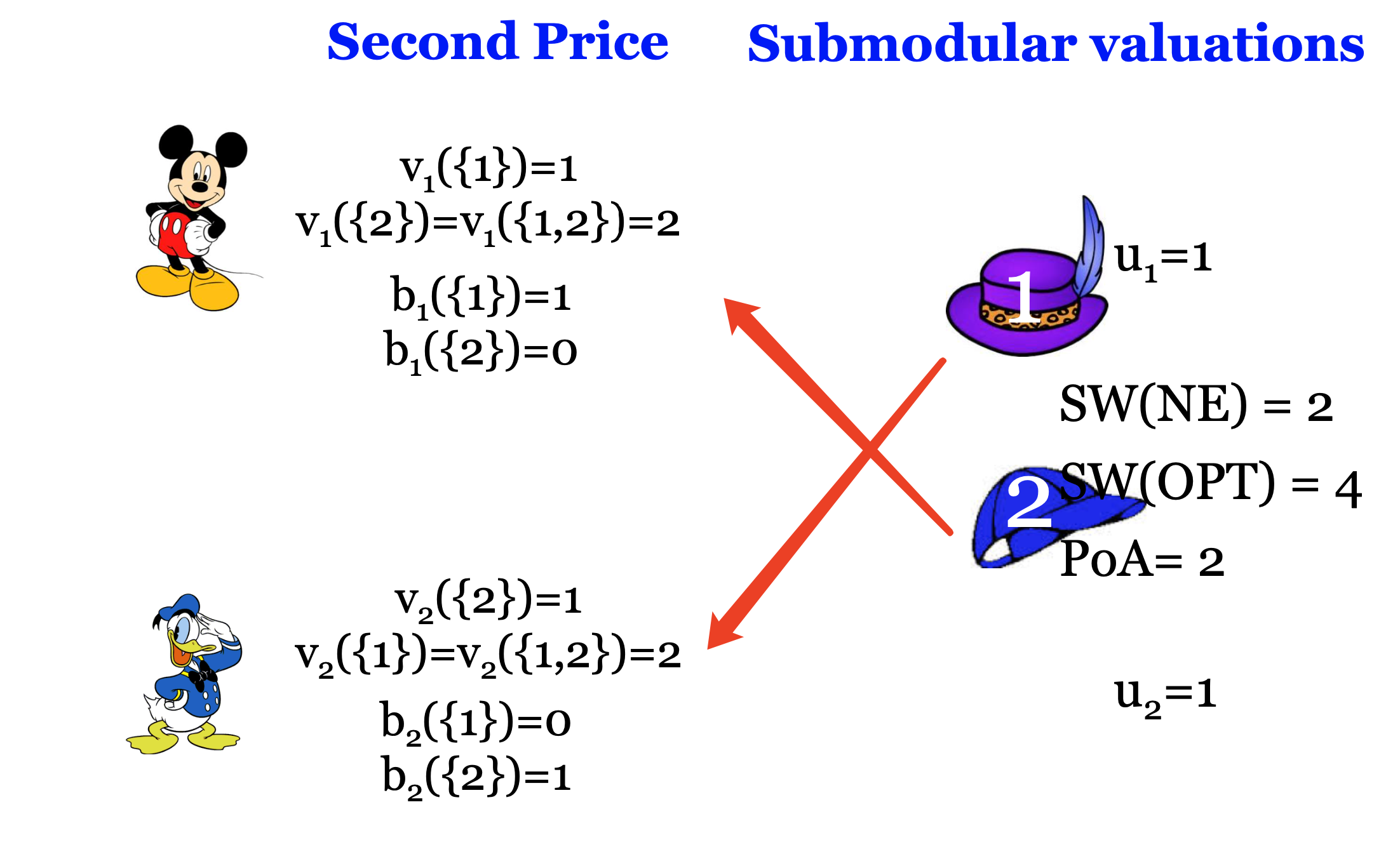
- PoA ≤ 4
The PoA of item-bidding (simultaneous) auctions is constant for using first, second or all-pay single-item auctions in subadditive valuations.
Food for thought
Suppose that we run a non-truthful mechanism that guarantees the following:
It maximizes the social welfare for (non-true) valuations vi(S) > v’i(S) > vi(S)/4 (where vi are the true valuation).
-
What is the approximation to the optimal social welfare?
-
Suppose that you have an incentive compatible mechanism with O(m1/2) approximation of the optimal social welfare. Is this a better mechanism? Why?
-
Can you see the connection of the first mechanism to the PoA? How easy is it to find an equilibrium?